FARM & RURAL SECURITY
Farm CCTV systems that work where mains power doesn’t reach
Farm CCTV and security cameras provide continuous visual monitoring of buildings, livestock areas, equipment yards and perimeter boundaries across rural properties. Unlike urban systems, agricultural installations must contend with power isolation, extreme weather exposure and the need for reliable night vision across large open areas—requirements that demand specialist design and deployment.
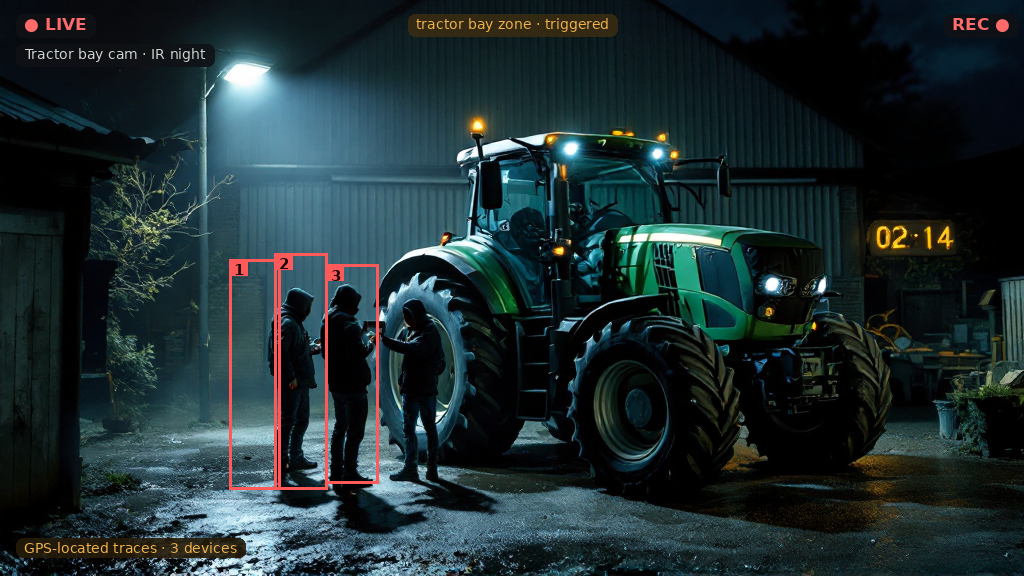
Farm CCTV systems deployed across rural holdings face distinct challenges that off-the-shelf consumer equipment cannot reliably address. Agricultural properties are characterised by distributed infrastructure—barns, silos, machinery stores, livestock enclosures and distant boundary fences—often without mains electricity in outlying areas. Weather exposure is continuous and severe: camera housings must resist prolonged rain, frost, high winds and temperature swings that would disable urban-grade systems within weeks. Night vision capability matters acutely on farms, where livestock theft, equipment vandalism and poaching typically occur between dusk and dawn. A rural security systems studio understands that effective CCTV on agricultural land requires specification decisions that urban installers rarely encounter.
The core architecture of a farm CCTV system must solve the power problem before any camera is mounted. Properties without mains supply to remote buildings require either solar panel and battery banks, 12-volt hardwired systems run from a central generator or UPS, or hybrid arrangements where primary recording happens at the farmhouse with wireless uplink from satellite cameras. Each topology carries different cost and resilience trade-offs. Solar systems offer genuine autonomy but demand sufficient daylight hours and careful battery sizing; 12-volt systems require buried or protected cabling but eliminate weather dependency; wireless systems reduce installation labour but introduce bandwidth constraints and latency. A farm CCTV installer must assess your property’s actual power topology, seasonal daylight patterns and cable routing options before recommending hardware.
Camera selection for agricultural environments diverges sharply from standard practice. IP cameras rated for outdoor use in urban settings often specify operating temperatures down to 0°C or −10°C; farm locations in northern regions, elevated terrain or exposed moorland regularly experience −15°C or lower, requiring cold-rated optics and sealed connector designs. Lens selection is also non-standard: barns and equipment yards benefit from wide-angle fixed lenses (90–120 degrees), whilst perimeter and livestock monitoring may require 4–8 mm lenses to resolve detail at 50–100 metres. Infrared illumination types vary too—passive infrared (thermographic) detects heat and works across fog or dust, whilst active infrared LEDs illuminate clearly but can spook livestock. A rural security systems studio will specify cameras matched to the actual surveillance task, not a generic ‘weatherproof’ label.
Recording and storage architecture on farms must account for both reliability and footage retention. Mains-powered DVR or NVR units at the farmhouse offer central management and can retain weeks or months of continuous footage, but rely on stable power supply; many farms add 24-hour UPS to protect against supply cuts. Remote storage via cloud upload offers redundancy but demands reliable broadband, which remains unavailable or unreliable across much of the UK’s agricultural regions. Hybrid approaches store high-resolution continuous footage locally and upload key motion-triggered events to cloud backup, balancing storage cost with rapid incident recovery. The recording system must also integrate with any existing farm management systems—access control for locked barns, alarm zones, environmental monitoring for livestock buildings—rather than existing as an isolated island of CCTV data.
Cabling and infrastructure installation on agricultural land presents obstacles that urban surveyors often underestimate. Power and data cables must cross open fields, cross or run alongside drainage systems, avoid machinery traffic routes, and resist rodent damage and UV degradation. Armoured or conduit-protected runs are standard; burial depth in farmland must account for ploughing, drainage maintenance and future building work. Camera mounting must withstand wind loads on exposed structures; barn installations often require additional reinforcement to roofing or wall fabric. Outdoor junction boxes and cable terminations must be sealed against moisture ingress and vermin. Installation labour on farms typically takes longer than equivalent urban work because of site access constraints, distances between buildings and the need to coordinate around farm operations—harvest schedules, livestock handling routines, machinery use—rather than working on static urban properties.
Maintenance and fault tolerance matter more on farms than in towns because downtime directly affects livestock welfare, security visibility and business continuity. A camera failure in an urban office is an inconvenience; a failed night-time monitoring system on a sheep farm leaves animals vulnerable to predation or theft throughout the dark hours until repair. Consequently, farm CCTV installations should include redundancy: dual cameras covering the same critical area, failover recording on secondary devices, or rapid-access spare components stored on site. Power supply resilience is equally critical—solar systems need battery monitoring and seasonal maintenance, generators need fuel supply assurance and regular exercise runs, and UPS systems need battery health checks. A rural security systems studio will build in maintenance schedules and spare parts availability from the outset, not treat them as afterthought.
Integration with other farm security and management systems amplifies the value of CCTV. Livestock monitoring systems that track animal movement can trigger CCTV recording on relevant zones; alarm systems for machinery sheds can activate camera capture on external approaches; gate access control systems can log when specific individuals enter high-value storage areas alongside visual confirmation. Integrated systems also provide farmers with unified dashboards—single app or web interface to view CCTV, check alarm status, review gate logs and receive alerts—rather than juggling separate platforms. This integration saves time in daily operation and accelerates incident investigation if theft or vandalism occurs. A studio experienced in farm security will design systems that speak to existing infrastructure and work practices rather than imposing alien technology.
Rural broadband constraints shape realistic expectations for real-time monitoring and cloud integration. Many farm properties lack reliable high-speed internet; those with broadband often rely on fixed wireless or satellite services with monthly data caps or variable latency. CCTV systems must therefore function effectively with limited or intermittent connectivity. Local storage and processing are essential; cloud upload is a bonus, not a dependency. Mobile app access to live feeds or playback works best on WiFi or 4G networks at the property, not as a primary remote-access tool over satellite. Understanding these constraints from the start prevents expensive system redesigns later and keeps clients satisfied with realistic performance.
The decision to install farm CCTV should emerge from a clear risk assessment: what assets require protection (livestock, machinery, fuel, feed, stored products), what threats are plausible (theft, vandalism, predation, trespass), what operational value does continuous visibility provide (stock welfare checks, equipment monitoring, staff accountability), and what budget supports the level of resilience needed. A rural security systems studio will conduct that assessment with you, translate findings into a specification, and install a system matched to genuine farm needs rather than marketing promises. The result is not glamorous infrastructure, but quietly reliable protection that outlasts its warranty and earns its cost by preventing losses and enabling faster incident response.
Explore KangalGuard by security system
Related security systems
Frequently asked
Can farm CCTV work without mains electricity?
Yes. Solar panel and battery banks, 12-volt hardwired systems from a central UPS or generator, and hybrid approaches all function reliably on isolated farm properties. The installer must assess your property’s power topology, seasonal daylight and cable routing before specifying the system.
What camera specification matters most for farm use?
Cold-rated optics (operating to −15°C or lower), sealed connectors, appropriate lens focal length for your coverage distance, and infrared illumination type suited to your livestock and environment. Standard ‘weatherproof’ urban cameras often fail within months on farms.
How do I store months of CCTV footage on a farm?
Local storage on DVR or NVR hardware at your farmhouse, backed by 24-hour UPS for power resilience. Cloud upload works best as selective backup of motion-triggered events rather than continuous streaming, because rural broadband is often limited or unreliable.
Should farm CCTV integrate with my alarm system or livestock monitoring?
Yes. Integration allows alarms or livestock alerts to trigger CCTV recording on relevant zones, gate logs to pair with visual confirmation, and unified dashboards to view multiple systems from one app. This saves time and speeds incident investigation.
How long does farm CCTV installation take?
Installation labour typically exceeds urban timescales because of distances between buildings, cabling through fields, coordination with farm operations, and structural reinforcement. A rural security systems studio will schedule around your farm’s routines and provide realistic timelines upfront.
Ten things YOU can do this week to make YOUR farm a harder target.
The Defence Kit is free, costs nothing to act on and needs nothing installed. Every one of the ten comes from a working Essex farm that was hit and from what the farms on the watch network report week by week. Take the ten steps first. If YOU still want cameras and a tripwire on YOUR gateways after that, we will come and walk the yard with YOU before YOU spend a penny.
Get the free Defence Kit