
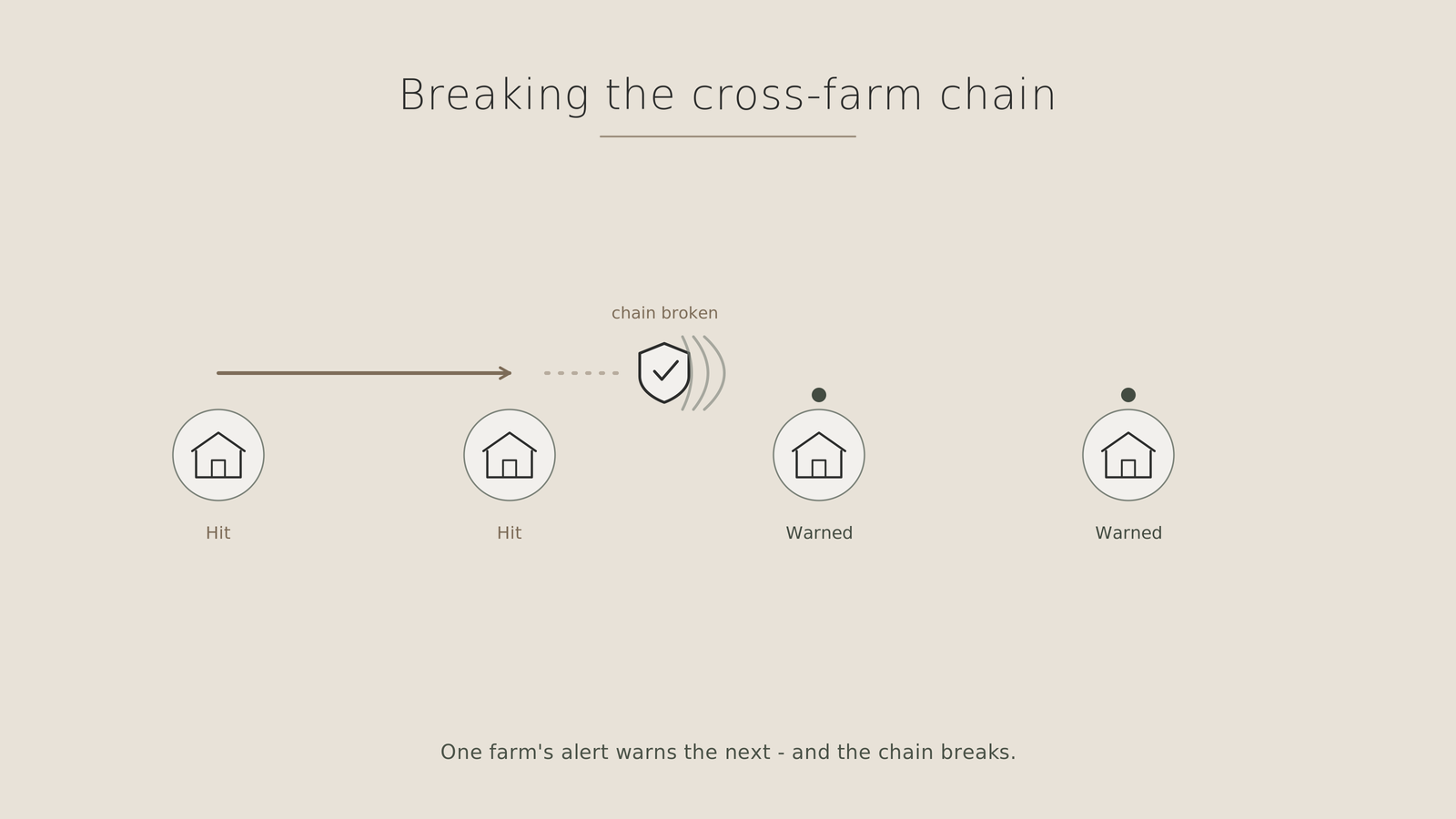
A rural property can record and alert entirely offline using a local recorder, point-to-point wireless video links, and motion-triggered sirens that need no internet connection. The internet only adds remote viewing convenience—a properly designed offline system sees, records and raises the alarm with no broadband dependency at all. Each job the internet usually does can be done another way, and on a farm where signal is weak or unreliable, it usually should be.
What three jobs does the internet normally do in a CCTV system?
The internet carries three functions in a typical consumer camera setup: it delivers live view to your phone via an app, it stores footage in cloud storage, and it sends motion alerts as notifications. Rural Britain has neither the broadband lines nor the mobile signal to run these reliably. Broadband exists on some farms but is often too slow or too unstable to carry continuous video without dropping frames or losing connection.
The good news is that CCTV predates the internet by decades. Each of these three jobs can be done locally, without any connection to the internet, and without losing any capability that matters on a working farm. When you move these functions offline—recording, alerting, and viewing—the system becomes faster to use, immune to a cut line, and keeps your footage entirely in your control.
How does a farm record video without cloud storage?
A local recorder—an NVR (network video recorder) or DVR (digital video recorder)—stores weeks of footage on its own hard disks, with no connection to anything beyond your property. This recorder sits in the farmhouse or a locked outbuilding, running on the farm’s own power supply backed by a battery-uninterruptible power supply (UPS). Local recording is not a compromise: it is faster to search than cloud footage, it works through a power cut, and it survives if the internet line is deliberately cut.
The recorder itself should sit out of casual sight, because thieves who know CCTV increasingly look for the box itself. A hidden or locked recorder that continues recording through a power outage is recording at exactly the moment trouble is most likely—during an intrusion when power or lines are cut. Weeks of footage remain on your own disks, searchable instantly without waiting for cloud downloads or relying on a connection that may not exist when you need it.
How does video travel from a remote barn camera to the farmhouse recorder?
Directional point-to-point wireless bridges carry video across long distances over open farmland with no cabling, no fibre, and no trench-digging. A camera mounted on a distant barn or boundary building feeds video wirelessly to a receiver connected to the farmhouse recorder. These radio links work reliably where line of sight exists—and most farmland has clear line of sight in abundance across open fields and pasture.
Each wireless link requires power at both ends: the remote camera and its transmitter run on solar panels with batteries sized for winter operation, while the receiver at the farmhouse connects to the main power supply. This approach eliminates the cost and disruption of running cable or fibre across fields, and the wireless link fails gracefully—if it loses power or signal, the remote camera simply stops transmitting, but the system degrades rather than collapsing entirely.
How do offline alarms work without internet alerts?
Motion events trigger layered alert paths that work entirely offline. A camera detects movement and sends a signal to the recorder, which immediately triggers local sirens and strobe lights at the point of intrusion—deterring the threat in real time without needing to send a message anywhere. Simultaneously, the recorder relays a warning signal by radio to the farmhouse, where a second siren and light alert you to an intrusion on the property.
Where any mobile coverage exists, a 4G/GSM module can send a fallback text alert as a secondary path—but this is a convenience, not the main alarm. The system is designed to degrade gracefully: sirens and lights keep sounding if the radio link fails; the recorder keeps recording if the power cuts; remote cameras keep transmitting on solar batteries if the main line goes down. Every layer that still has power does its job when the others fail. This principle—local-first, internet-optional—means the system works in the blackspots where thieves assume it cannot.
Why does camera placement matter more in an offline system?
In a system where nobody is idly scrolling a live app all day, camera placement becomes critical. Each camera must be positioned to identify rather than merely observe. Place cameras at face height and registration-plate height at gates, doorways, and pinch points where access is natural. This means footage captures the details needed to identify a person or vehicle, not just the fact that something moved.
Infrared performance must be checked at the actual distances involved on a dark night, not in a showroom under bright lights. A camera with good infrared on a barn wall 30 metres away is far more useful than a high-megapixel camera that produces dark silhouettes in the fields beyond your boundary. Fewer cameras placed strategically for identification will yield more actionable evidence than many cameras placed for coverage alone.
How should power be managed in a fully offline CCTV system?
Power follows the same off-grid logic as the rest of the system. Remote cameras and wireless bridges run happily on solar panels with lead-acid or lithium batteries sized for winter operation—when daylight is shortest and charging slowest. The central recorder at the farmhouse draws from the main property power supply, backed by a UPS to ride out cuts lasting hours. A system that records through a power cut is recording at the exact moment an intrusion is most likely, because cutting power is an old trick used by people who know CCTV exists.
Every component should be reviewed for its power consumption and backup duration. Solar systems for remote equipment need oversizing to account for cloud cover and short winter days. The farmhouse UPS needs capacity to support the recorder through realistic cut durations—minutes at minimum, ideally hours. This redundancy costs less than the cost of footage that stops recording the moment a thief cuts the line.
Can an offline farm CCTV system still offer remote viewing?
Yes, but as a convenience rather than a dependency. A recorder that has no internet can be given a connection without breaking the system’s independence. Where broadband or mobile coverage exists, remote viewing from your phone while you are away is genuinely useful—but the system must not need it. The principle is dependency, not abstinence: the system must never need the internet to see, record or raise the alarm.
If you choose to add remote viewing, it runs as a secondary path that only works when a connection is available. The system keeps recording and alerting offline whether or not you can reach it remotely. This is the opposite of systems that depend entirely on cloud storage or internet alerts—those fail silently in rural blackspots, whereas a properly designed offline system works best where the internet fails.