
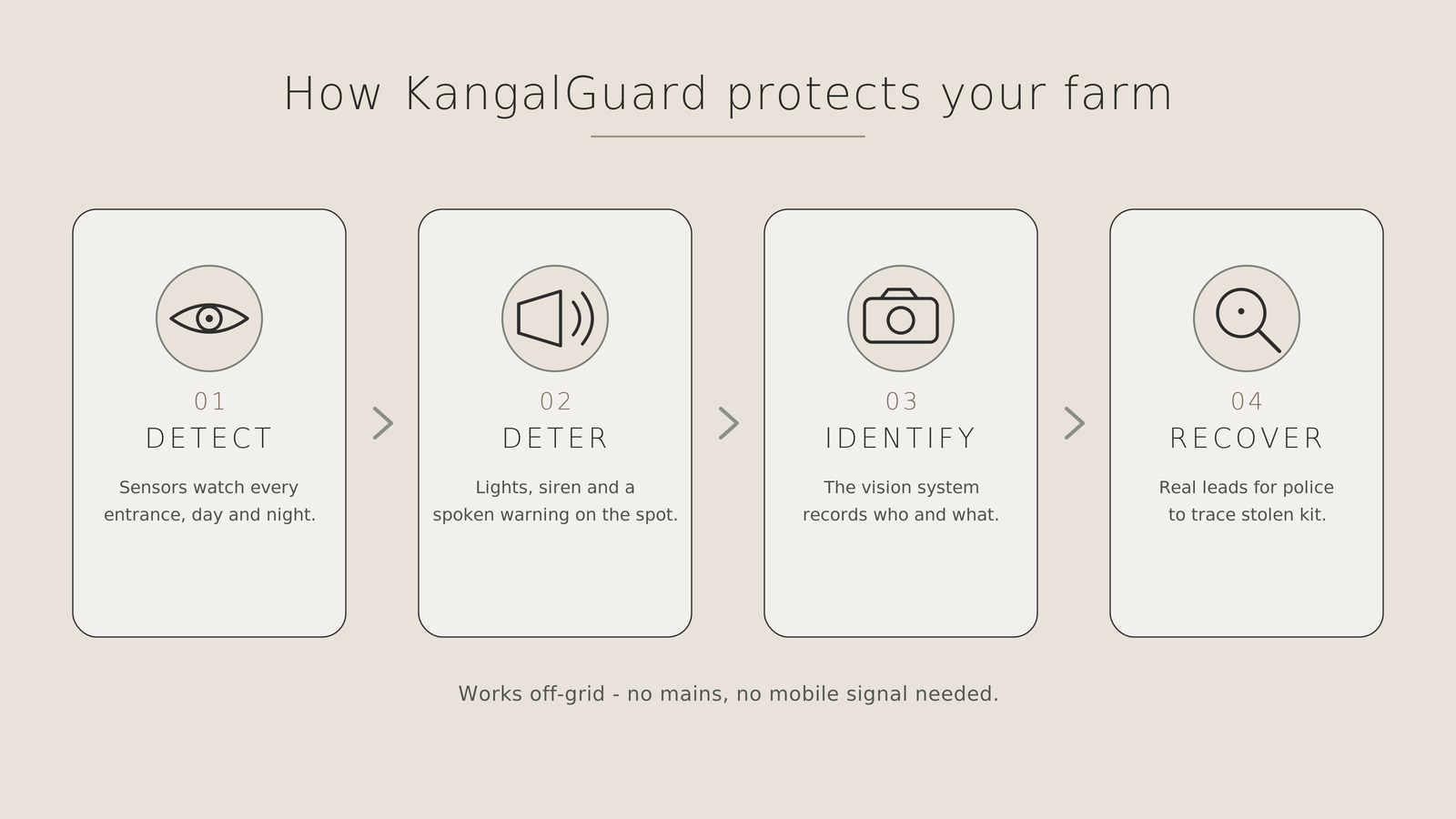
Burglars avoid properties with visible, monitored alarm systems combined with robust physical barriers and fast police response times. Rural properties face distinct risks: isolation, delayed response and low foot traffic make them targets. Effective rural security combines detection, deterrence and rapid intervention—not a single product.
Why isolation makes rural properties vulnerable
Rural burglars exploit distance. A farm two miles from the nearest neighbour allows time to work without witnesses. Response times in rural areas often exceed thirty minutes; urban response can be five. This delay is the burglar’s advantage. Properties without visible security systems or monitored alarms become obvious targets because an intruder can operate undetected and undisturbed. The absence of visible deterrence signals opportunity.
Physical remoteness also means fewer passersby, fewer cameras on neighbouring properties, and limited natural observation. A burglar conducting reconnaissance in daylight on a rural property faces far less chance of being noticed or challenged than on a suburban street. This reconnaissance window—the time a criminal spends planning a job—is longer in rural settings, making visible security measures essential to interrupt that planning process early.
What visible deterrents actually stop a burglar's approach
Visible alarm box signage and system branding are the first filter. Research into burglar decision-making consistently shows that obvious, recognisable system badges reduce target appeal. A property displaying monitored alarm branding signals two things: someone is watching, and police will respond. Burglars spend seconds assessing risk; visible systems extend that risk assessment and often shift attention to an easier property nearby.
Security cameras positioned at entry points work similarly. A camera covering the main approach, front door and vehicle parking area tells an intruder that footage exists, identification is likely, and conviction risk is real. Cameras must be visible, positioned logically (not hidden), and clearly functional. Dummy cameras do not work; burglars now expect to see working systems and check for signs of actual operation—cable runs, power sources, realistic positioning.
Window and door contacts that trigger alarms when opened create active, measurable response. Unlike passive barriers, these generate noise and alert monitoring centres in real time. A burglar forcing entry and triggering an immediate alarm faces police dispatch within minutes in monitored properties, even on rural holdings. The speed of that response transforms the risk calculation entirely.
Why monitored alarms create faster police response than unmonitored systems
An unmonitored alarm generates noise but nothing more. A burglar inside a rural property with an unmonitored system can disable it, smash it, or ignore it knowing that no one is being notified. Monitored systems, by contrast, trigger immediate human verification and police dispatch from a control centre. The property owner does not need to be present or aware; the system speaks directly to law enforcement.
Police prioritise monitored alarm calls because they carry third-party verification. A monitoring centre confirms that a system has been breached, not that a householder has made a mistaken call. This credibility compresses response time significantly. On a rural farm, a monitored system breach can result in police dispatch within minutes, whereas an unmonitored alarm may never generate police attendance at all if neighbours do not report it or if the property is too isolated for sound to carry.
This response-time advantage is the core reason monitored systems deter burglars more effectively than any other single measure. Burglars operate on time pressure; they expect a window of fifteen to twenty minutes on an unmonitored property. Monitored systems collapse that window to five minutes or less, making the risk unacceptable.
Physical barriers: locks, gates and access denial
Security systems work best when combined with physical barriers that slow entry. Heavy-duty locks on external doors, reinforced door frames, and security bars on vulnerable ground-floor windows increase effort. A burglar entering through a window or door wants speed; reinforced access points force noise, tool use, and extended time in view of cameras or monitoring systems. The combination of physical delay and electronic detection is far more effective than either alone.
Farm properties benefit from perimeter control: gates that slow vehicle and foot access, gravel or sensor mats that create noise before an intruder reaches the building, and clear demarcation of private property. These do not stop determined criminals, but they extend the visible security footprint and force decision-making at multiple points. A gated farm with visible monitoring systems signals professional-grade security from the boundary.
Lighting, especially motion-activated lighting at entry points, removes cover and forces an intruder to work in visibility. Burglars prefer darkness and concealment; well-lit approaches are avoided in favour of darker properties. Combined with cameras, lighting becomes a recording tool as well as a deterrent.
Why certain vulnerabilities attract burglars to rural properties
Poor visibility from the road, overgrown access points, and absent or outdated security systems are the classic markers burglars seek. A farmhouse set back from a lane with no visible alarm branding, no external cameras, and no lighting looks undefended. Conversely, a property where security is obvious—working CCTV, alarm branding, perimeter lighting, and gated access—becomes less attractive the moment a burglar spots these markers.
Properties with valuable assets stored externally—quad bikes, tools, fuel, machinery—but minimal security attract targeted theft. A burglar may travel specifically to a rural area to steal high-value farm equipment, but will choose targets where external security is weakest. Visible systems and gates protecting these assets shift the target away from defended properties and towards unprotected ones.
Building a rural security strategy that deters rather than just reacts
Effective rural security operates in layers. First, visible deterrence: branding, cameras, gates and lighting make the property obviously defended. Second, active detection: alarm contacts on doors and windows, motion sensors in barns or outbuildings, and window glass-break detectors create immediate alerts. Third, rapid response: monitored systems ensure police dispatch before a burglar has time to work. Fourth, physical barriers: reinforced access points, secure storage, and perimeter control increase effort and time. None of these alone will stop a determined criminal, but combined, they transform a rural property from an easy target into a defended one.
The burglar’s decision is made in seconds, based on visible security markers and time-to-effort calculation. A property that looks defended, alerts quickly, and brings police within minutes becomes economically irrational to target. The burglar moves on to a property with weaker signals.