
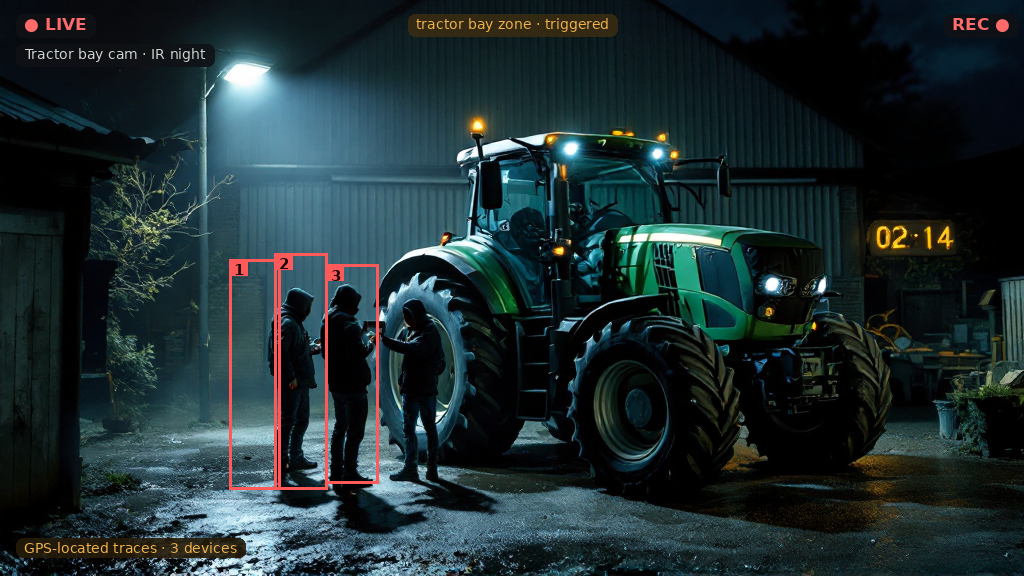
The best 4G security camera for a farm or rural property is one that delivers reliable footage in locations where mains power and fixed broadband do not exist. 4G connectivity, solar or battery power, weather resistance, and local storage form the core requirements. Success depends on matching the camera’s capabilities to your specific site conditions and coverage needs, not on brand reputation alone.
Why 4G matters for farms and remote locations
Rural properties often lack the infrastructure that urban and suburban security systems take for granted. Mains electricity may be distant or unreliable; fixed-line broadband either does not reach the property or carries prohibitive costs. 4G (cellular) connectivity bypasses these barriers. A 4G camera connects directly to a mobile network, transmitting footage in real time without dependence on WiFi routers, cable runs, or site surveys for underground ducting.
For farms, this translates to live monitoring of livestock housing, grain stores, equipment yards, and perimeter access points from a phone or computer, regardless of distance from the farmhouse. 4G also enables rapid deployment: a camera can be installed and operational within hours, rather than weeks of groundwork and infrastructure planning. In the context of rural theft and trespass, this speed of response matters.
What are the core technical requirements for a working 4G camera system?
A functional 4G camera needs four components working in concert: a cellular module (the ‘4G’ part itself), a power source independent of mains grid, weather protection, and local or cloud storage for footage. Without any one of these, the system fails or becomes unreliable.
The cellular module must support the frequencies and bands used by UK mobile networks. Not all 4G cameras do; some are built for North American or European standards that do not align with Vodafone, O2, EE, or Three coverage patterns. Before purchase, verify that the camera is certified for UK networks and that your chosen provider offers strong signal at your property’s location. Network coverage maps are publicly available; cross-check your site against them.
Power is the second critical factor. Mains-powered 4G cameras require a weatherproof supply and backup battery; battery-only cameras need either solar panels or frequent manual charging. Solar-powered systems work well on south-facing locations with minimal seasonal shading; north-facing or heavily shaded sites may struggle to maintain charge through winter. Battery-only cameras suit short-term deployments or low-use scenarios; for continuous monitoring, solar or mains hybrid systems are more reliable.
How does storage work when internet upload is slow or intermittent?
Rural 4G connectivity is often faster than rural broadband, but it is not guaranteed to be constant. A camera relying solely on cloud storage (uploading every frame to an external server) will lose footage if the signal drops. The best 4G cameras include local storage—a microSD card slot, or on-device NVR (network video recorder) capability—that records continuously to the camera itself or a nearby device. When the 4G signal returns, the camera syncs stored footage to the cloud.
This hybrid approach ensures you do not lose critical footage during signal loss, which is common in rural areas during bad weather or network congestion. If you cannot access the camera to retrieve a microSD card, cloud backup is essential; if you can visit the site regularly, local storage alone may suffice. Understand your camera’s storage limits: a 64 GB microSD card records approximately 8–14 days of continuous high-definition footage, depending on compression settings.
What weather and durability standards should a rural camera meet?
A camera mounted on a barn, gate post, or equipment shelter will face rain, frost, UV exposure, and temperature swings of 40°C or more across seasons. The camera’s enclosure must carry an IP (Ingress Protection) rating of IP65 or higher; IP67 is preferable for high-exposure sites. IP65 means the device is dust-tight and can withstand direct water jets; IP67 adds temporary immersion resistance. Ratings below IP65 are not suitable for outdoor rural use.
Check also for temperature operating ranges. Many consumer-grade cameras specify operation only between 0°C and 40°C; UK winter conditions regularly drop below zero. Professional rural security cameras specify operation down to −20°C or lower. Lens fogging is another issue; a heated lens or anti-fog coating prevents condensation from obscuring footage on cold, damp mornings. Mounting hardware must be stainless steel or powder-coated steel to resist rust in wet farm environments.
What features distinguish a camera fit for farm use from a general-purpose one?
General-purpose 4G cameras are designed for home gardens, parking spaces, or light commercial premises. Farm and rural security demands more. Look for cameras with motion detection and configurable alert zones—so you are not flooded with notifications every time wind moves a hedge or a bird lands on a post. Night vision (infrared or low-light capability) is essential if monitoring happens after dusk or in poor weather; a camera without it will show nothing useful once the sun sets.
For livestock or equipment yards, a wide field of view (110° or greater) reduces blind spots and the number of cameras needed. Pan-and-tilt capability (motorised movement) or multiple fixed cameras can cover large areas; fixed installations are more reliable in rough environments. Audio recording is less commonly needed on farms, but can be valuable for detecting intruders or unusual sounds in animal housing. Ensure any audio feature complies with privacy law if the camera overlooks neighbouring land.
Finally, consider the user interface. A rural property owner may have poor WiFi; the camera’s app or web interface must work smoothly over 4G alone, without requiring a local WiFi network to configure or adjust settings. Some cameras require a local hub or NVR to function; others work standalone. Standalone is simpler for rural deployment.
How do you evaluate a 4G camera provider and support model?
A 4G camera system is only as reliable as the provider behind it. Before purchase, ask: Does the supplier support ongoing network connectivity issues, or do they expect you to troubleshoot with the mobile network operator? If the camera fails, what is the replacement turnaround? Is firmware updated regularly to patch security vulnerabilities? For rural properties, poor support can mean weeks without monitoring during a critical period.
Request references from other rural or farm customers, not just testimonials from suburban users. A camera that works reliably in a town garden may perform poorly on a moorland farm with borderline 4G signal and high wind exposure. Check whether the supplier offers site surveys or signal testing before installation; a reputable provider will do this at no cost to identify potential issues before equipment is purchased and mounted.
Monthly subscription fees for cloud storage and app access vary widely. Understand what you are paying for: cloud backup alone, 24-hour video retention, or premium features like person detection or smart alerts. For cost-sensitive farm operations, systems with optional cloud (local storage only) may suit better than those requiring paid subscriptions.