
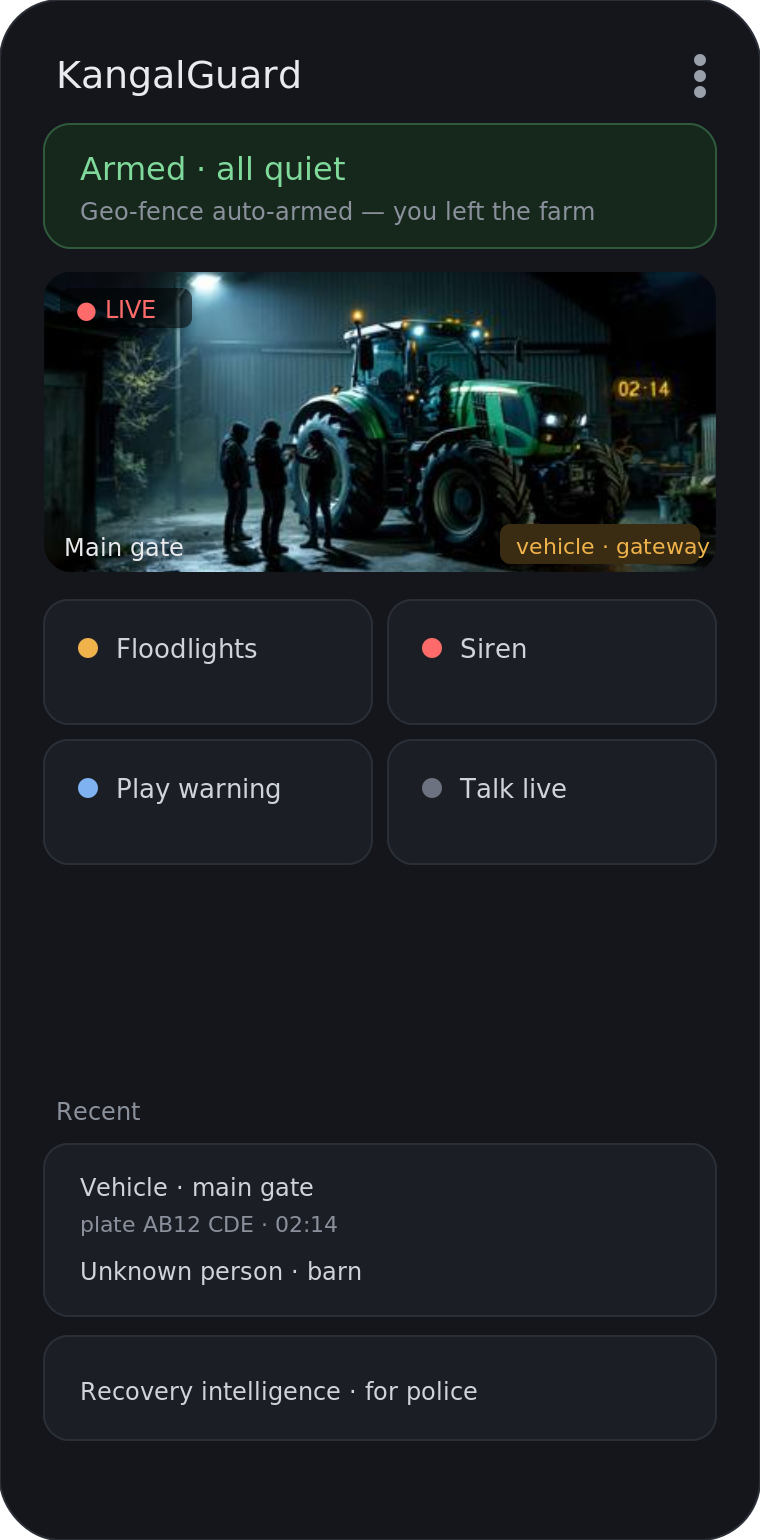
A farm alarm is a monitored or unmonitored detection system designed to alert you to unauthorised entry, movement, or damage on agricultural land and buildings. It combines sensors placed at vulnerable points — barns, gates, machinery sheds, boundary fences — with a control panel and often a professional monitoring service that responds to alerts in real time. Farm alarms differ from domestic systems because they account for large perimeters, livestock movement, weather exposure, and the reality that many holdings operate remotely or outside standard hours.
How does a farm alarm system work?
A farm alarm operates in layers. Sensors detect intrusion or unauthorised access at entry points — doors, windows, gates, and boundary fences. These might be magnetic contact switches (which trigger when a door or gate opens), passive infrared detectors (which sense body heat and movement), or vibration sensors (which detect cutting or forced entry). When a sensor is triggered, it sends a signal to a control panel, usually mounted in a secure location such as a farmhouse or office.
The control panel receives the signal and initiates the alarm protocol. If the system is monitored by a professional security station, the alert is transmitted immediately, and a trained operator assesses the incident. Some systems allow operators to listen to microphones on-site or view CCTV footage before dispatching a response. Unmonitored systems simply sound an audible alarm on the property and send a notification to your phone. Either way, the goal is rapid awareness and swift response to potential theft or intrusion.
Modern farm alarms integrate with other security infrastructure. CCTV cameras often work alongside sensors, capturing footage of any triggered event. GPS-enabled livestock trackers may be linked to the same system. Motion-activated lighting can be triggered by the same sensors, discouraging intruders. This layered approach means each component reinforces the others, reducing false alarms and improving the chance of deterrence or evidence recovery.
Why is a farm alarm different from a domestic security system?
Domestic alarms are designed for compact, occupied properties with clear boundaries. Farms and rural holdings present different challenges: perimeters often span several hectares, buildings are spread across the land, and many holdings are unoccupied for long periods. A barn theft can occur hours before anyone notices. Livestock and wildlife movement must not trigger false alarms, or the system becomes unreliable. Weather — wind moving gates, heavy rain on sensors — can create noise that a domestic system would misinterpret.
Farm alarms account for these realities. Sensors are more robust and weatherproof. The control panel is often positioned where signal strength and coverage are reliable across a larger area. The monitoring service understands rural response times and may liaise directly with local police farm crime officers. Installation often requires site surveying to identify the most vulnerable access points, rather than a standard room-by-room approach. The system is calibrated to your specific holding layout, not a template configuration.
What parts make up a typical farm alarm system?
The control panel is the brain of the system. It receives signals from all sensors, stores event logs, and communicates with the monitoring station. It needs reliable power (often battery-backed) and strong signal coverage, whether by landline, broadband, or mobile. On exposed holdings, installers will survey signal strength and may recommend a booster or secondary connectivity path.
Sensors vary by location and threat. Entry-point sensors (magnetic contacts on doors and gates) are the simplest. Perimeter sensors might include taut-wire fencing (which detects cutting or climbing) or vibration detectors on gates. Internal sensors in sheds and barns detect movement and theft in progress. External PIR (passive infrared) sensors detect people on the approach to buildings.
Alerting devices include a siren (audible deterrent), a bell box (visible flashing light on the building exterior), and notification to your phone and a monitoring station. Some systems include two-way audio, so operators can speak to intruders and confirm false alarms. CCTV and recording devices are often integrated, so any alarm event triggers camera footage capture. Backup power supplies ensure the system stays active during mains failure.
What threats do farm alarms address?
Rural theft is the primary driver. Diesel fuel, agrochemicals, power tools, quad bikes, and livestock are high-value, portable, and often stored in unlocked or poorly secured buildings. Barns and sheds may be isolated, dark, and invisible from neighbouring properties. An alarm system makes theft riskier: the audible siren draws attention, the flashing bell box signals monitoring, and a rapid response from police or the monitoring service cuts the time an intruder has to load and leave.
Boundary and perimeter breaches are another concern. Fences may be cut to allow livestock theft or unauthorised access to farm roads. Taut-wire sensors or vibration detectors on gates provide early warning of these attempts. For holdings near public rights of way or with anti-social history, perimeter monitoring offers peace of mind.
Weather and accident monitoring can also form part of a farm alarm brief. Grain store alarms alert to temperature or moisture spikes. Slurry tank sensors detect overfill. Livestock monitoring systems detect escaped animals. These are extensions of the core intrusion alarm but represent the broader security mindset on modern holdings.
Should you choose monitored or unmonitored?
A monitored farm alarm transmits alerts to a professional control centre 24 hours a day, 365 days a year. When a sensor triggers, an operator is notified, assesses the event (often via camera or two-way audio), and can contact police or dispatch a rapid-response team. The service costs more, but you gain expert judgment, accountability, and the likelihood of a faster, more coordinated response. For high-value holdings or those remote from police stations, monitoring is often the better choice.
An unmonitored system alerts you directly via SMS or push notification and sounds an alarm on-site. You retain control and pay no subscription, but you depend on your own ability to respond — which may mean being unavailable during an intrusion, or being unable to act quickly enough to prevent theft. Unmonitored systems suit holdings where occupants are usually on-site and can respond immediately.
Many holdings use a hybrid approach: unmonitored alarms with very rapid local notification, supported by CCTV and documentary evidence for insurance claims. The choice depends on your risk profile, occupancy patterns, and how quickly you or local responders can reach the property after an alert.
What should you consider before installing a farm alarm?
Site assessment is essential. Before specification, a surveyor should visit the holding to map vulnerable entry points, assess signal coverage, identify power supplies, and understand your daily routines and occupancy. A barn accessible only by a long farm track needs different sensor placement than one visible from a public road. An exposed site may require weatherproof sensors; a sheltered holding might allow more standard components. Without this survey, a system installed to domestic templates will fail.
Integration with existing CCTV or access control systems should be planned early. Insurance providers often require specific technical standards (such as NSI Gold certification for monitored services). Building layout, budget, and maintenance capacity all influence whether you choose a simple perimeter system or a comprehensive multi-zone approach.
Training and familiarity matter. You and your staff must understand how to arm and disarm the system, what constitutes a false alarm, and how to respond to genuine alerts. Poor training leads to disarmed systems, ignored alerts, or false calls to police. A conversation with a specialist installer helps ensure the system fits your holding and your habits.