
The Farm Security Administration (FSA) was a New Deal agency established in 1935 to support struggling American farmers during the Depression; it was absorbed into the Department of Agriculture in 1946 and ultimately dissolved. For UK farm operators considering security systems today, understanding this historical shift matters because rural protection evolved from government-led initiatives into the hands of private installers and farm operators themselves—a transition that shapes how modern farm security is planned and delivered.
What was the Farm Security Administration and when was it established?
The Farm Security Administration was a US federal agency created in 1935 under President Franklin D. Roosevelt’s New Deal programme. Its primary mandate was to assist tenant farmers, sharecroppers and other rural workers affected by the Great Depression and the Dust Bowl crisis. The FSA provided loans, land purchases, resettlement assistance and educational programmes to help rural families stabilise their operations and improve their standard of living. It represented one of the earliest large-scale government interventions in agricultural support across the United States.
The agency also became known for its documentary photography programme, which captured rural American life during the 1930s and 1940s. This visual record, produced by photographers including Walker Evans and Dorothea Lange, remains one of the most significant historical archives of Depression-era farming communities. The FSA’s work extended beyond financial aid; it sought to reshape rural infrastructure, education and living conditions through a comprehensive approach to agricultural welfare.
When did the Farm Security Administration end, and why was it dissolved?
The Farm Security Administration was formally absorbed into the US Department of Agriculture in 1946, just after the end of the Second World War. By that time, the post-war economy had begun to recover, reducing the acute need for Depression-era relief programmes. Political opposition to the FSA’s mandate also grew; critics argued that its land purchase and resettlement programmes represented excessive federal intervention in private agricultural enterprise. Conservative lawmakers increasingly questioned the agency’s scope and philosophy.
The agency was not abruptly shut down but gradually wound down as its programmes were transferred to other USDA divisions. Some of its functions, particularly loan administration, were inherited by successor agencies. However, the FSA’s original mission—direct support for small and struggling farmers—was largely abandoned. The shift marked a turning point in American agricultural policy, moving away from direct government assistance towards a model that emphasised market-driven farming and commercial consolidation.
How did the end of the FSA change rural support and agricultural security?
With the FSA’s dissolution, responsibility for farm viability and protection shifted dramatically. Farmers increasingly had to rely on commercial lending, insurance and their own resources rather than government programmes. This transition occurred as mechanisation was accelerating, farm sizes were expanding and rural communities were beginning to consolidate. The withdrawal of federal support coincided with—and arguably accelerated—the decline of small-scale farming across America and the rise of larger commercial operations.
For rural security specifically, this shift had long-term implications. Where the FSA had supported comprehensive rural development, including infrastructure and community wellbeing, the post-1946 landscape left individual farmers responsible for their own asset protection. This context is relevant to UK farm operators today: rural security has never been a centralised government function in the UK to the same extent, which means UK farmers have always relied more heavily on private security solutions, insurance partnerships and their own infrastructure decisions. Understanding this history helps explain why private farm security systems became standard practice.
What does the FSA’s history teach us about modern farm security planning?
The FSA’s trajectory from centralised support to devolution teaches an important lesson: farmers cannot assume long-term external protection or subsidy. Rural security planning must be self-directed, proactive and built into the farm’s own infrastructure strategy. This principle applies squarely to UK farm security today. A farm’s protection against theft, trespass, livestock loss and equipment damage depends on decisions made by the farm operator themselves—choices about CCTV placement, perimeter monitoring, lighting and alarm systems.
Modern farm security systems must account for the reality that rural areas remain under-resourced by public emergency services relative to urban centres. A farm’s security posture is therefore a private responsibility. When a prospective farm operator or manager considers security options, they are in effect taking the same practical step that post-1946 American farmers had to take: investing in their own protection infrastructure. This is not a burden unique to the UK, but it is a pattern that became entrenched after large-scale government rural support ended in the US—a pattern now global.
How should UK farmers approach security planning today, given this context?
The absence of centralised rural security provision means UK farm operators benefit from approaching security as a tailored, site-specific decision rather than a standardised package. Each farm’s layout, stock type, equipment value and geographic isolation creates different risk profiles. A security system designed for a lowland dairy operation will differ materially from one protecting an upland sheep farm or an arable business with high-value machinery storage. The best starting point is a clear audit of what needs protection, where vulnerabilities exist and what level of monitoring and response the farm can sustain.
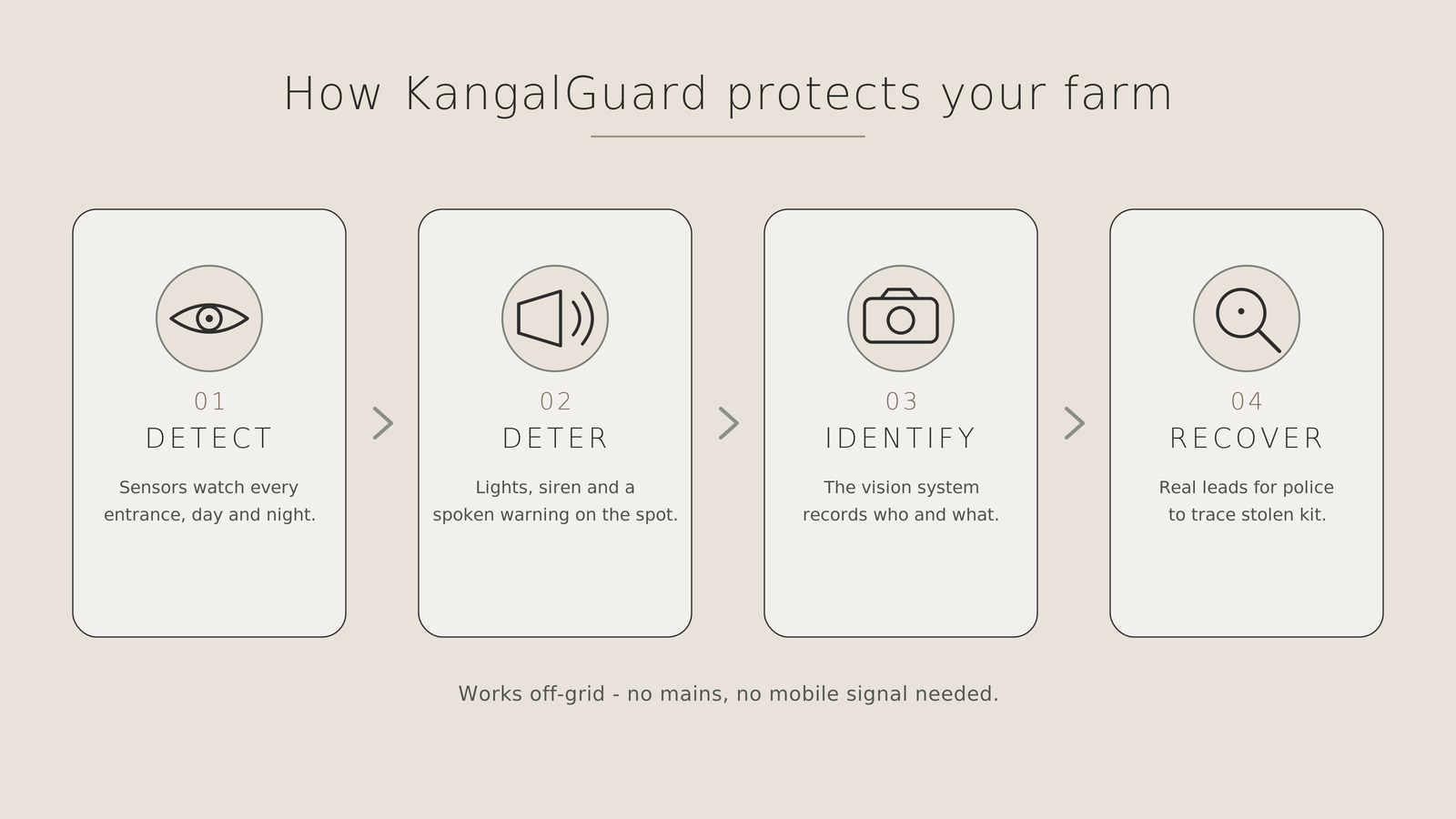
Effective farm security typically combines multiple layers: physical barriers (fencing, gates), environmental design (lighting, sightlines), surveillance (CCTV, perimeter sensors) and response capability (alarms linked to monitoring or local response). The right combination depends on the farm’s specific circumstances. Working with a specialist in rural security systems allows farm operators to avoid both under-investment (leaving assets unnecessarily exposed) and over-specification (paying for capacity the farm does not need). The history of the FSA serves as a reminder that rural protection is a farmer’s own strategic concern, not a government function—and that clarity about responsibility leads to better planning.
Where can UK farm operators find professional guidance on security planning?
UK farms seeking to develop or upgrade security systems should work with installers and consultants who understand rural risk, agricultural infrastructure and the practical constraints of farming operations. A professional rural security specialist will conduct a site assessment, identify vulnerabilities, recommend appropriate technologies and help integrate systems into the farm’s day-to-day management. The goal is not to impose a generic solution but to design a system that fits the farm’s physical layout, operational rhythm and budget.
Prospective clients should expect a security consultant to ask detailed questions about the farm’s geography, asset values, current incidents or concerns and existing infrastructure before recommending any system. Getting in touch with a farm security specialist early in the planning process helps clarify priorities and avoid costly mistakes. The transition from FSA-era government support to modern private security may seem distant, but it underscores a timeless truth: rural security is most effective when it reflects the farm operator’s own knowledge of their land and risks.