
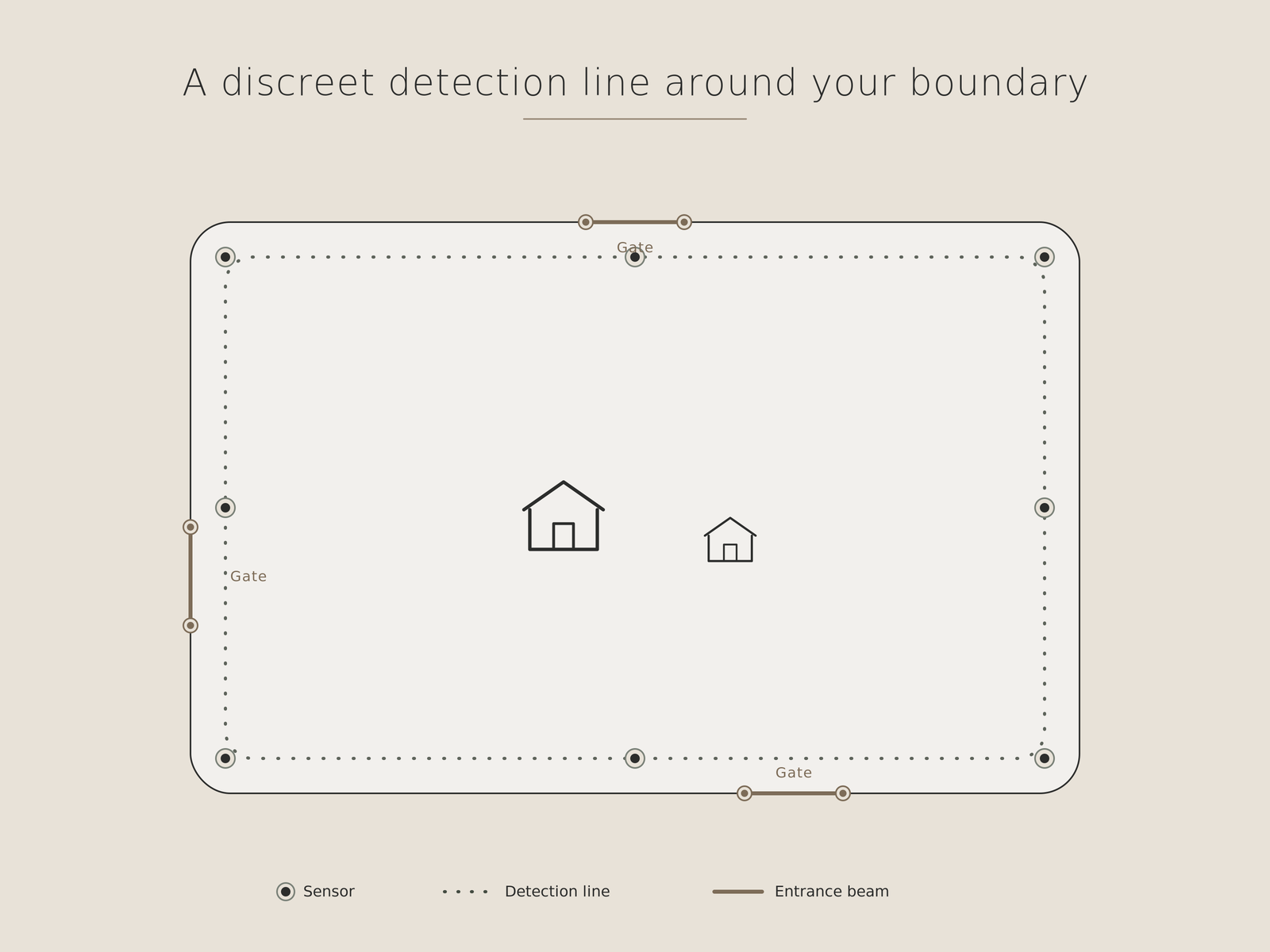
Infrared beam sensors detect movement across invisible light barriers to trigger alarms when fences, fields or buildings are breached. They work by transmitting an infrared beam between a transmitter and receiver; when an object interrupts the beam, the circuit breaks and activates your security response. This makes them cost-effective for perimeter protection on rural properties where wired alarms suit the landscape better than cameras alone.
What exactly does an infrared beam sensor do?
An infrared beam sensor is a two-part detection system: a transmitter sends a continuous infrared beam to a receiver across an open space — typically along a fence line, across a gateway, or around a building entrance. When the beam is interrupted by an object or person, the receiver detects the loss of signal and triggers an alarm or alert to your security system. The system does not identify what interrupted the beam; it only registers that the beam has been broken.
The key strength of infrared beam sensors is their simplicity and reliability. Because they rely on line-of-sight transmission of light rather than motion-detection algorithms or image processing, they are less prone to false alarms caused by wind-blown leaves, small animals, or lighting changes. On farms where environmental conditions are unpredictable — dense vegetation, dust, changing daylight — this straightforward principle of operation makes them a dependable first line of perimeter defence.
Where on a farm do infrared beam sensors work best?
Infrared beam sensors perform best when protecting defined access points and linear boundaries where the beam path is unobstructed. A common farm application is across a gateway or entrance; the sensor mounts on gateposts to detect anyone or anything entering the property. They also suit fence lines where the field is relatively clear of tall crops or dense shrubs that might shadow the beam. Along tracks leading to remote farm buildings, or around the perimeter of an equipment yard, they provide a cost-effective alert that someone has crossed the boundary.
Rural properties with long driveways benefit from beam sensors placed at the property entrance to flag when a vehicle or person has entered the land, giving you advance notice of visitors or trespassers. Some farmers install pairs of beams at slightly different heights to distinguish between large vehicles (which break both beams) and small animals (which may break only the lower beam), allowing your system to ignore false alarms from livestock or wildlife whilst alerting you to human or vehicle intrusion.
What are the technical limits of infrared beam sensors?
Infrared beam sensors require a clear, unbroken line of sight between transmitter and receiver. If the beam path crosses dense vegetation, dust clouds, or heavy rain, the signal may degrade or drop entirely, triggering false alarms or failing to detect genuine intrusion. On working farms where dust from vehicles or seasonal changes in hedgerow cover are common, this limitation is material; the sensors need regular maintenance to keep the beam path clear.
Range is another practical constraint. Most farm-grade infrared beam sensors operate effectively across distances of 10 to 50 metres, though longer-range units exist at higher cost. Alignment is critical: the transmitter and receiver must be precisely aimed at one another, usually within 1 to 2 degrees. Movement due to wind, settlement, or livestock impact can knock the system out of alignment, and realignment requires physical access to both sides of the protected area. For this reason, they work best on stable structures like gateposts or building walls, not on flexible fencing.
How do infrared beam sensors integrate with a wider farm security system?
A single infrared beam sensor is a detection tool, not a complete security solution. Its role is to identify that a boundary has been breached and send a signal to your alarm control panel or monitoring service. The control panel then decides what happens next: it might sound a local siren, send a push notification to your phone, trigger a light, or alert a professional monitoring centre to dispatch a response. The choice depends on your security strategy and the value you are protecting.
Farm security systems typically layer multiple detection methods. A beam sensor at the entrance gate identifies that someone has entered the property; CCTV cameras covering the approach and the farm buildings then show you who or what it is; access control on shed and barn doors adds a second perimeter. When combined, these systems provide both detection (the beam) and verification (the camera), which is essential for distinguishing genuine threats from false alarms caused by weather or wildlife. A professional farm security installer will advise on how many beam sensors you need, where to place them, and how to integrate them with your wider detection and response infrastructure.
What maintenance and reliability issues should you expect?
Infrared beam sensors are mechanically simple and generally reliable, but they demand regular checking. Dust, spider webs, algae, or rain droplets on the transmitter or receiver lens will degrade or block the beam. In rural settings — around farmyards, on exposed fence lines, or in damp fields — lens contamination is routine. Most systems include a signal-strength indicator so you can see whether the beam is weakening; some require you to physically inspect and clean the lenses quarterly or after heavy weather. Neglecting this maintenance will eventually result in nuisance alarms or undetected breaches.
Power supply is another consideration. Most infrared beam sensors run on 12V DC, supplied either from a mains-powered control panel or from a dedicated power supply. On remote properties without mains electricity, battery backup or solar-powered units may be necessary. Check the battery life specification: a system that drains its battery in six months will leave you unprotected if inspections are neglected. Temperature extremes also matter; very cold winters or hot summers can affect the performance of electronic components, so confirm that any sensor you choose is rated for the climate conditions on your farm.
How do you decide if infrared beam sensors are right for your property?
Choose infrared beam sensors if you have defined access points (gates, entrances to buildings), clear sight lines, and access to regular maintenance. They are most cost-effective when protecting linear boundaries or narrow passages rather than large open areas. If your priority is early warning — knowing the moment someone or something crosses a boundary — rather than detailed identification, a beam sensor delivers that well. They are also a sensible choice if you are sceptical about motion-detection technology on a working farm where wind, dust, and wildlife create constant environmental noise.
Avoid relying on beam sensors alone if you need to identify intruders or verify threats. They are a perimeter detection tool, not a surveillance system. If you are protecting high-value assets or livestock, combine them with CCTV so you know what triggered the alarm. If your property is heavily wooded, has dense hedgerows, or experiences frequent fog or heavy rain, assess how often the beam path would be obstructed and consider whether environmental conditions make them impractical. A professional assessment of your site — the layout, the distances, the climate, the maintenance capacity you can commit to — will reveal whether infrared beam sensors suit your farm. Contact a rural security specialist to discuss your specific perimeter and what combination of detection methods will serve you best.