
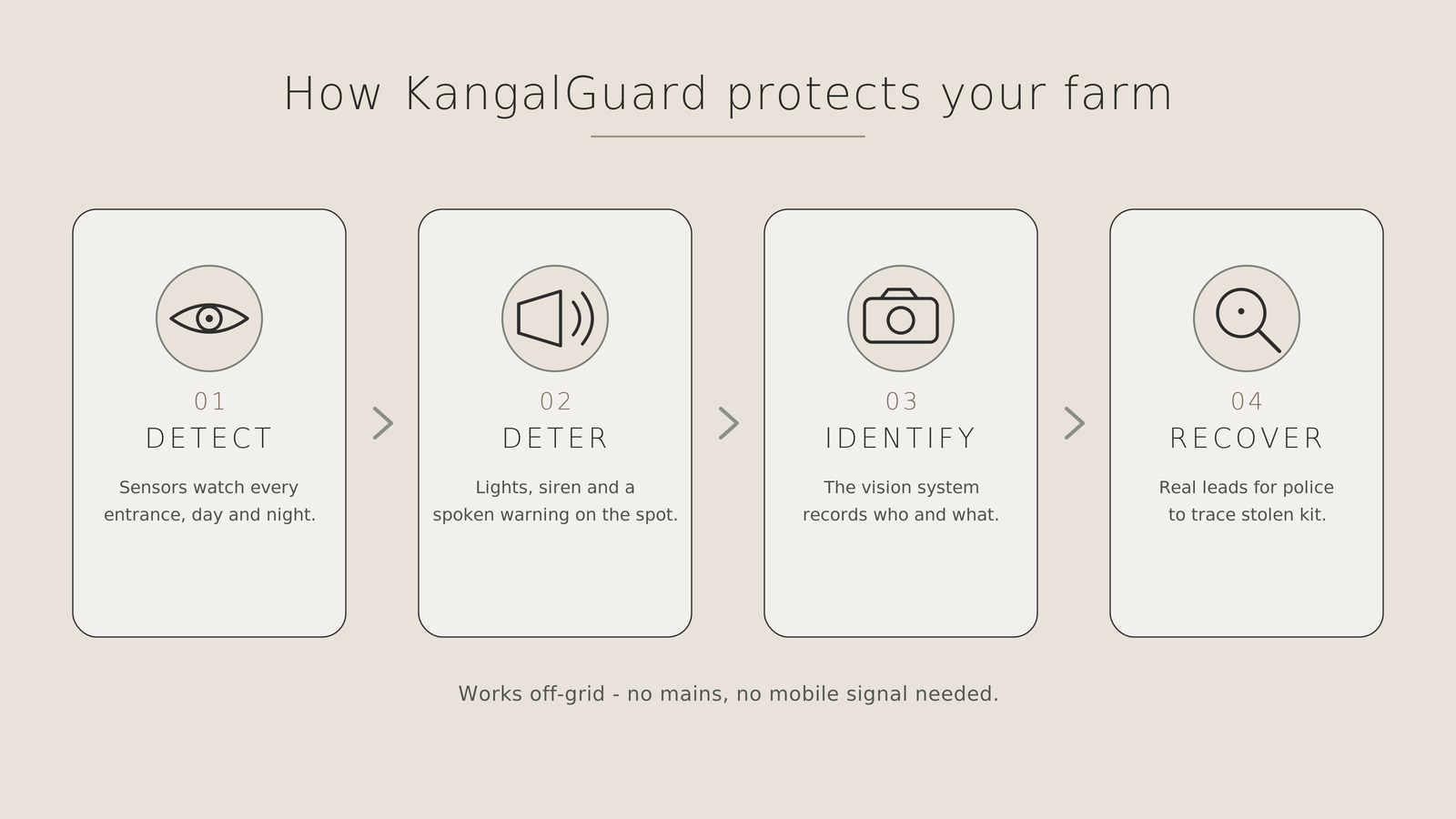
Indoor security cameras protect your farmhouse and rural property by recording activity in hallways, living spaces and entry points — but their effectiveness depends entirely on placement, network resilience, and legal compliance with privacy law. This guide covers what to evaluate before installation, how professional surveys work, and the real constraints you’ll face.
Why indoor cameras matter for rural properties
Rural homes face distinct security challenges. Distance from police response, isolated access routes, and seasonal occupancy gaps create vulnerabilities that outdoor perimeter systems alone cannot address. Indoor cameras record evidence of break-ins, theft, and property damage — and they act as a deterrent when visible.
For farmhouses with high-value equipment stored indoors, grain stores, or residential quarters above working buildings, internal monitoring bridges the gap between perimeter detection and actionable evidence. A camera positioned at a main hallway or stairwell captures movement that outdoor systems miss; one trained on a workshop or storage room documents what was taken and when.
Where indoor cameras actually work best in a farmhouse or rural home
Placement trumps camera quality. Entry hallways, kitchens adjacent to exterior doors, and stairwells are high-value zones because they capture anyone moving through the property. These spaces are typically well-lit during daylight and benefit from natural sightlines. A camera at a bedroom or living area door records access without intruding into private sleeping or relaxation spaces.
Avoid positioning cameras where they create blind spots or redundancy. Two cameras covering the same stairwell waste installation time and storage; one well-positioned camera on a landing captures ascent and descent. Rooms without exterior access or secondary exit points are lower priority unless they contain high-value items or equipment.
Rural properties often have multiple buildings — a main house, workshop, grain store, or animal housing. Indoor cameras in the main residence are most effective when paired with robust outdoor coverage of perimeter approaches and building entries. A professional survey identifies which interior zones justify the cost and disruption of installation.
What to check before you commission a survey
Network connectivity underpins every indoor camera system. Rural broadband is often unreliable: spotty Wi-Fi, poor 4G coverage, or satellite internet with high latency all affect how cameras transmit footage and alert you to incidents. Before scheduling a survey, confirm your internet specification with your provider — upload speed in particular matters because cameras constantly stream data. A surveyor will assess whether your existing network can handle multiple cameras without degrading other services.
Power supply and cable routing are practical constraints most homeowners underestimate. Wired cameras require runs through walls, attics, or under floors to reach power and network connections. Wireless cameras demand reliable power points or frequent battery changes. In older farmhouses with solid stone walls or asbestos cladding, running cable becomes expensive or impossible without structural work. Identify potential cable routes before a survey begins.
Storage capacity is often overlooked. Footage from multiple cameras, recorded continuously, consumes hard drive space quickly. Local storage (a recorder in a cupboard) is reliable but requires physical access for maintenance; cloud storage offers remote access but depends on consistent internet. Understand your retention requirements — how many days or weeks of footage do you need to store? — because it determines the system you need.
Legal and privacy considerations for indoor cameras
UK Data Protection Act 2018 and GDPR require that you do not use cameras to monitor areas where people have a reasonable expectation of privacy — primarily bathrooms and bedrooms where occupants are changing or using toilet facilities. You may legally record hallways, kitchens, living rooms, and other communal spaces. If you employ staff who work on or live on your property, you must inform them that cameras are in use and provide written notice of recording.
If your property is rented to seasonal workers, tourists via holiday let, or long-term tenants, privacy obligations are stricter. Tenants have the right to know cameras are present and the purposes for which footage is retained. Breaching these rules can result in enforcement action by the Information Commissioner’s Office and civil claims from individuals whose privacy was violated.
Cameras trained on neighbours’ land or windows create dispute risk. Position cameras to cover only your own property. If your farmhouse sits close to a neighbour’s boundary, discuss the installation beforehand to avoid conflict and legal challenge. A surveyor experienced in rural properties knows these pitfalls and will advise on compliant positioning.
What a professional survey reveals
A surveyor attends your property to assess interior layout, lighting, power availability, network reach, and access for cable installation. They identify which rooms justify cameras and where placement will deliver the best coverage without blind spots or false alarms. The survey typically includes photographs and notes on obstacles — thick walls, existing pipes or cables, listed building restrictions — that will affect design and cost.
The surveyor will also evaluate your current network infrastructure. They may recommend upgrading Wi-Fi, adding network switches, or improving power distribution to support the system reliably. Rural properties often have older electrical systems or dispersed buildings that require infrastructure changes before cameras can be installed properly.
A detailed survey report becomes your specification. It clarifies the number and type of cameras needed, cable routes, storage requirements, and any structural work required. This report allows you to understand the scope and make an informed decision before committing budget. It also forms the basis for an accurate installation quote and timeline.
Next steps: making a decision
Indoor camera installation is not a universal solution. It suits properties where indoor spaces contain valuable equipment, where exterior perimeter detection is already in place, or where you need evidence of activity inside your home. For isolated farmhouses or rural cottages where break-ins are rare, outdoor perimeter systems and robust locks may be sufficient.
If you decide to proceed, request a survey from a studio that works regularly with farm and rural properties. They understand the specific challenges: unreliable internet, architectural constraints, tenant or employee notification, and the integration of indoor systems with outdoor perimeter monitoring. A free survey clarifies what is possible, what it costs, and whether it solves your actual security problem. Contact us to arrange a survey for your property.