
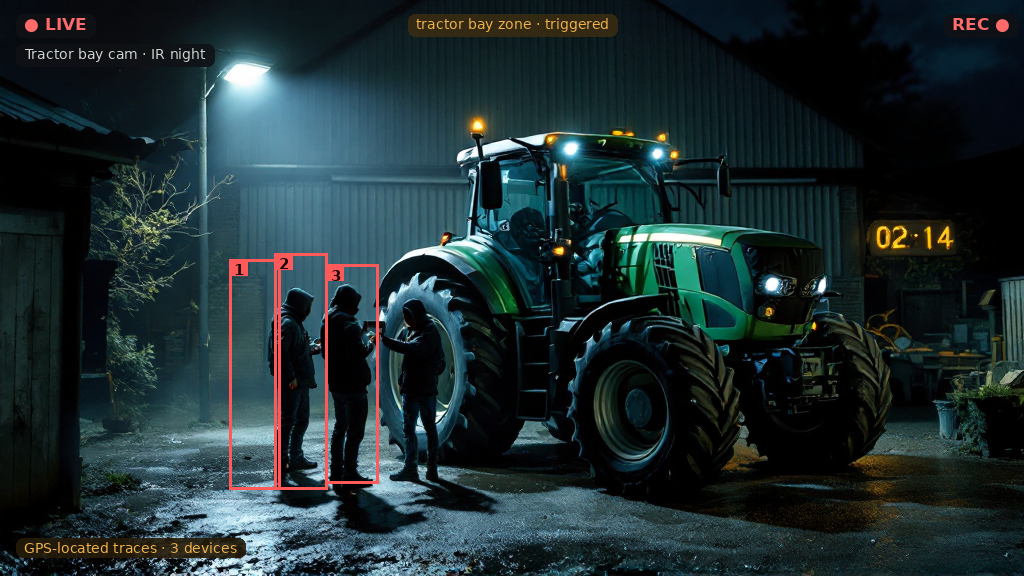
Driveway alarms are genuinely useful for rural and farm properties where response time matters and early warning of approaching vehicles prevents loss. They work best as part of a layered security approach, not as a standalone solution. Their value depends entirely on your property layout, isolation level, and what threats you’re actually trying to deter.
What a driveway alarm actually does
A driveway alarm detects a vehicle or person crossing a perimeter trigger—usually a passive infrared sensor, pressure mat, or beam—and sends an alert to a receiver or your phone. The moment an intruder, visitor, or lost vehicle enters your drive, you know. This early warning is the core value proposition. Unlike CCTV, which records after the fact, or perimeter fencing, which you cannot monitor constantly, a driveway alarm gives you real-time notification when your attention is elsewhere: in a barn, on a field, in the house, or asleep. On isolated rural holdings, this advance notice can mean the difference between catching trespassers, livestock thieves, or fly-tippers before they reach valuable assets—or discovering the loss hours later.
The system does not stop anyone. It alerts you. What you do with that alert—call police, check CCTV footage, confront the visitor, secure livestock—is your responsibility. A driveway alarm is therefore most effective when paired with a plan: clear sight lines, external lighting, visible cameras, and a willingness to act on the alert quickly. In rural areas where police response times can exceed 30 minutes, that gap between alert and arrival is critical.
When driveway alarms deliver real value
Driveway alarms are most worthwhile on properties where the drive is long, the house is set back from the road, or the buildings are not visible from public areas. If your farm entrance is half a mile from your main dwelling, a driveway alarm gives you hours of effective deterrent and awareness that a visitor has arrived. They are also valuable where theft or trespass is an active problem—livestock theft, machinery theft, or unauthorized recreational access are common rural issues. If you have experienced loss or attempted intrusion, an alarm system becomes investment in prevention, not hypothetical security.
Driveway alarms are particularly relevant on holdings with multiple entry points or where you cannot physically monitor the approach. A smallholding with a long drive, open fields, and a single track entrance benefits far more than a suburban property with a 10-metre driveway visible from the kitchen window. Similarly, if you work away from the house during the day—on the land, in outbuildings, or off-site—an alarm extends your practical awareness to cover the periods when you are genuinely blind to approach.
Real limitations and what they cannot do
Driveway alarms do not prevent entry. They do not deter a determined offender who knows about the system and does not care. They generate alert fatigue if positioned too sensitively—false alarms from wind-blown debris, animals, or heavy rain can lead to alarm blindness, where you stop reacting. They also require reliable power and signal: wireless systems depend on battery life and radio range; wired systems need careful installation and are harder to extend. Weather, particularly heavy rain or snow, can trigger false positives in some sensor types.
They are also incompatible with high-traffic situations. If you have multiple visitors, deliveries, or workers using the driveway daily, constant alerts become noise rather than warning. Public roads shared with neighbours will trigger alarms from their traffic. A driveway alarm assumes you live in a quiet, controlled-access situation; on a busy farm lane or near a public right-of-way, their signal-to-noise ratio drops significantly. Finally, driveway alarms alone do not constitute a security system. They are a detection tool, useful only if you respond to them.
How driveway alarms fit into a complete approach
Rural security professionals recognize that driveway alarms work best as one layer in a broader strategy. A driveway alarm alerts you; CCTV records the incident; perimeter fencing and gates control access; visible signage deters casual trespassers; and good lighting makes approach uncomfortable. In isolation, a driveway alarm is a pressure relief valve—you feel more aware, but you are not materially safer. Combined with other measures, it becomes part of a system with real teeth. An intruder knows they are observed from the moment they enter the drive, that their actions are recorded, that the occupants are alerted, and that escape is complicated by fencing or gates.
This layered approach also protects against false confidence. A driveway alarm alone might tempt you to believe you are secure when you are simply notified. That is the trap: notification feels like prevention. Genuine rural security requires response capability—the ability to move quickly toward the threat, call police, or protect assets. If you install a driveway alarm but have no clear view of the drive, no external lighting, no ability to reach the property boundary quickly, and no plan for what comes next, the alarm is more reassurance than utility.
The question to ask before buying
Before investing in a driveway alarm, ask: What am I trying to prevent, and can I respond to an alert? If the answer is “I want to know when someone arrives” and you can act on that knowledge, a driveway alarm is valuable. If the answer is “I want something to stop intruders” or “I want to feel safer,” an alarm alone will not deliver. Be clear on your actual threat. Have you experienced theft or trespass, or are you responding to anxiety? If loss has already occurred, an alarm is pragmatic investment; if it is purely precautionary, the money might serve better elsewhere—better gates, better lighting, better CCTV placement.
Also consider your property layout. Is the drive visible from your house? Can you reach the gate quickly? Is there mobile signal for alerts? Are there clear sight lines for CCTV or for your own visual response? On a tight, visible plot with good road frontage, a driveway alarm adds little value. On a long, isolated drive with poor visibility and response time measured in minutes, it changes the calculation significantly.
Making the decision: a practical summary
Driveway alarms are worth it if you own a remote or isolated rural property, have experienced loss or trespass, have a long drive or multiple entry points, work away from the house, and can respond quickly to an alert. They are poor value if you live near a busy public access, have high traffic, cannot act on alerts, or are using them as a substitute for perimeter control or CCTV. In most cases, they are not a standalone purchase; they are a component of a larger security plan. If you are considering a driveway alarm, spend equal time planning response: lighting, visibility, gates, and the decision rule for what you will do when the alarm sounds. A system that alerts you but leaves you helpless is expensive reassurance. A system that alerts you and lets you respond is security.