
4G security cameras work well on farms where mobile signal is strong and consistent, but rural coverage is patchy—many properties sit in dead zones or suffer weak signal. Before choosing 4G, you need to verify your actual signal strength on-site. This guide helps you assess whether 4G suits your farm, or whether hardwired and hybrid systems are safer bets.
What makes 4G cameras different from wired or hybrid systems?
4G cameras transmit footage over mobile networks instead of fixed broadband or copper cabling. They offer flexibility: no trenching, no reliance on fixed-line providers, and they’ll work anywhere with adequate signal. On paper, this appeals to farms spread across large acreages without existing infrastructure. In practice, 4G performance hinges entirely on one thing—whether your site actually has usable signal.
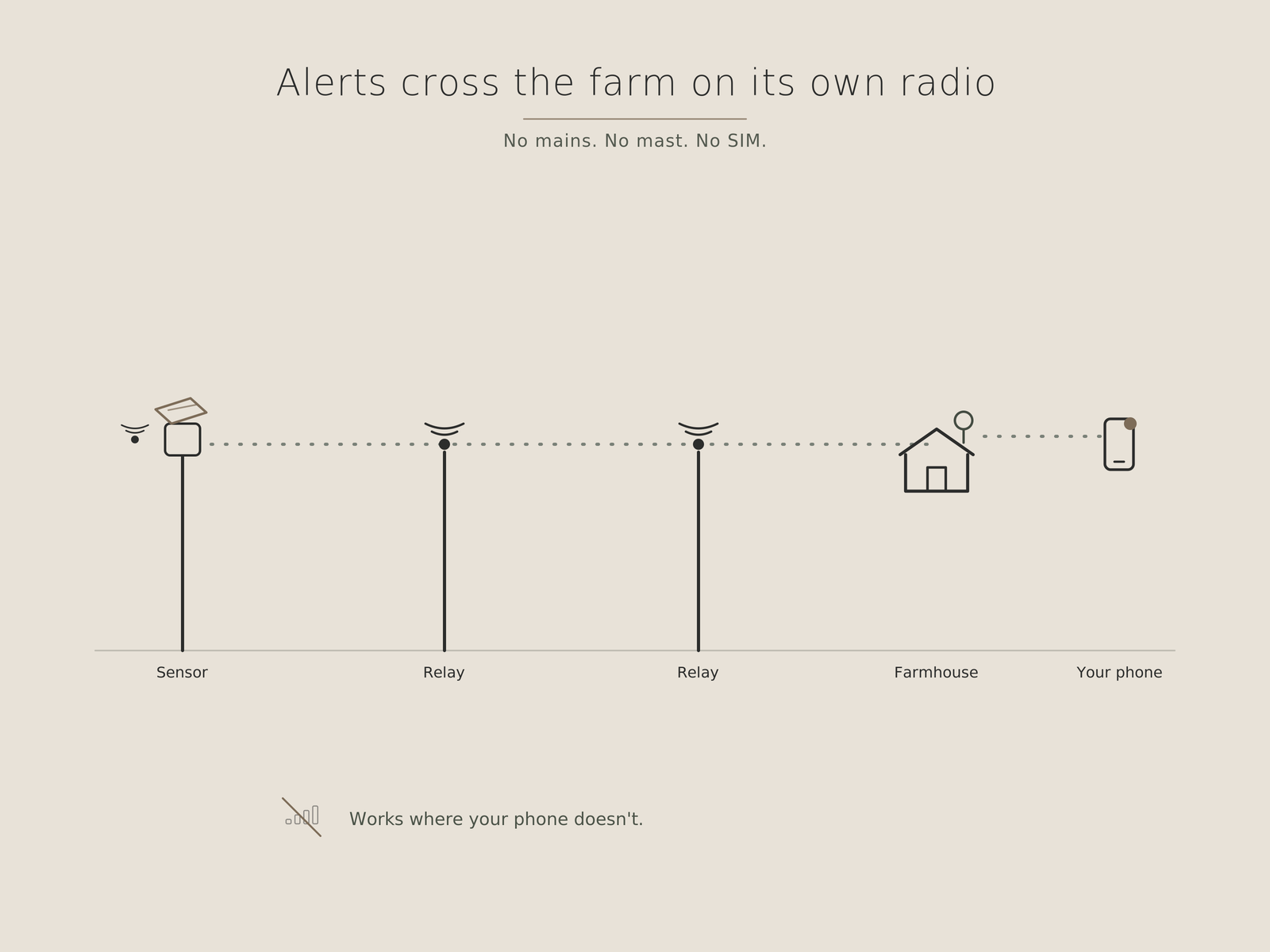
Wired and hybrid systems (combining wired cameras with wireless backhaul or 4G fallback) give you a baseline: footage moves through your own cabling or mesh networks first, and only switches to 4G if the primary link fails. Rural properties often benefit from this hybrid approach because it doesn’t bet everything on a single carrier’s coverage map.
Why do 4G cameras often fail in rural areas?
Rural signal weakness stems from distance to mast, terrain, and building materials. A farm two kilometres from the nearest mast might show ‘good’ signal on a phone but still suffer buffering and dropouts when a 4G camera tries to stream continuous video. Mobile operators prioritise urban and suburban coverage; rural areas sit at the edge of their networks and suffer during peak hours. Bad weather, high winds, and seasonal vegetation changes also degrade signal stability.
The second problem is power consumption. 4G modems draw significant current, especially under poor signal conditions when they transmit harder to maintain connection. A battery-powered 4G camera drains far faster than a wired one, or even a wireless camera on a local network. If your property lacks mains power near camera locations, you face regular recharging or solar panel installation for each unit.
How do you know if 4G will actually work at your farm?
Operator coverage maps are misleading. They show approximate service areas, not signal strength at ground level or inside buildings. Before committing to 4G cameras, conduct a real-world test: use a dedicated signal-strength meter (not just a phone) to measure dBm readings at each intended camera location and at the building where you’ll monitor footage. Signal below −120 dBm typically causes streaming problems. Signal below −130 dBm means 4G is unreliable for video.
Request a site survey from your installer. A proper survey measures signal in the actual locations where cameras will sit—not just near the farmhouse. This is not a cost; it’s a prerequisite to making an informed choice. If your installer skips this step and sells you 4G based on a coverage map alone, that’s a red flag.
When does 4G work well on rural properties?
4G suits farms close to mobile masts, with strong, stable signal (above −110 dBm), where cameras can be powered from mains supply, and where recording requirements are modest—say, real-time alerts on high-value assets rather than 24/7 stored footage. It also works as a redundancy layer: a farm with primary wired or fibre links can use 4G as a fallback if the main connection drops, triggering alerts and brief clips without relying on 4G alone.
Single-camera installations on outbuildings or gateways are another legitimate use case. If you need one camera on a barn 200 metres from the house and can’t run cabling, a well-sited 4G unit with mains power can be effective. The key is modest ambition: one or two cameras, good signal, and acceptance that 4G is the primary solution, not a backup.
What hybrid and wired alternatives are stronger for farms?
Many farms benefit more from wired systems run through buried conduit or overhead runs to a central recorder. Installation costs are higher upfront, but the system is stable, power-efficient, and immune to carrier outages. Wireless cameras on a dedicated local network (using 5 GHz mesh or proprietary protocols) offer flexibility without relying on third-party mobile infrastructure. 4G can then sit as a pure fallback—monitoring the network health and alerting you if the primary link fails, without expecting it to carry all live footage.
A hybrid approach is often the answer for larger rural properties: wired cameras covering the high-priority areas (buildings, gateways, machinery storage), wireless mesh extending to secondary zones, and 4G as a monitored standby. This trades some upfront cost for genuine reliability. Rural properties large enough to need multiple cameras almost always find this balance more cost-effective than rolling the dice on 4G alone.
What questions should you ask your installer?
Ask whether they propose 4G as a primary or secondary system. If primary, ask for proof of on-site signal testing—not a coverage map. Ask about their fallback plan if signal proves inadequate after installation: Will they remove the system? Will they refund or credit toward a wired alternative? Honest installers welcome these questions and build them into their survey process.
Ask about power supply for each camera, maintenance requirements (battery replacement, solar panel servicing), and how they handle carrier outages. Ask what footage is stored locally on the camera or recorder versus transmitted live. Ask whether they offer hybrid system design that uses 4G only where it makes sense. If an installer won’t discuss these details, find another one.