
Off-grid farm security relies on three elements working without the grid: solar-powered detection at perimeter chokepoints, immediate local deterrence through lights and sirens, and radio-based alerts that reach your farmhouse and neighbours without touching the internet. The discipline begins not with choosing equipment, but with accepting that power and communication must work independently of infrastructure the farm has never had.
Why the grid’s absence changes everything about farm security
Most security systems make three silent assumptions: mains electricity, a broadband connection and a mobile signal. On a working farm, any or all of those assumptions fail exactly where the risk is highest — the far yard, the field gateway, the barn at the end of the track. A motion sensor without power is decoration. A camera that cannot send its alert is evidence no one will ever see. Off-grid security is the discipline of rebuilding detection, deterrence and alerting to work anyway.
The first question in off-grid design is not which camera to buy but how each device will be powered and how its warning will travel. A sensor that cannot raise you is dead weight. This reframes the entire system architecture: power must come from solar panels and batteries sized for winter, not summer — the system must survive weeks of low light with margin to spare. Alerts must travel by radio links that carry warnings across the farm without touching the internet at all. The system that works in December, in a power cut, without a phone line, is the system that actually works.
Where should detection start on an off-grid farm?
Detection belongs at the perimeter, not at the farmhouse door. By the time an intruder reaches the yard, your options have narrowed to confrontation or loss. The natural places for motion detection and beam sensors are the chokepoints a vehicle cannot avoid: field gateways, track entrances and boundary pinch points where a vehicle must slow, turn or stop. An alert raised at the gateway buys minutes of warning. An alert raised at the barn door buys seconds.
On a limited budget, this distinction matters. Coverage of open fields adds significant cost without adding much early warning. Chokepoint detection — properly positioned at the entry points where a raider has no alternative but to pass through — delivers the warning time that changes outcome. The same principle applies to camera placement: position cameras for identification at chokepoints rather than wide, pretty views of empty fields. Number plates, faces and timestamps that stand up in court come from positioned evidence capture, not from panoramic coverage of darkness.
How do you deter intruders on a farm no one can reach quickly?
Deterrence works best when it is immediate and obviously local. Lights that snap on, sirens that sound at the point of intrusion and visible, well-maintained physical measures change the economics of a raid in the first few seconds. Most rural intruders are not determined professionals; they are opportunists testing whether anyone is paying attention. A farm that responds instantly, in the dark, at the far end of a track, reads as a farm that is watching.
This is why off-grid deterrence is powered deterrence. A siren that sounds only when someone manually triggers it from the farmhouse is a siren that sounds too late. A light triggered by motion detection at the gateway is a light that answers before you even know there is a problem. Local, autonomous response — powered by the same solar and battery system that powers detection — means the farm reacts faster than any distance allows. That reaction, visible in the dark, is the message that shifts a raider’s calculus away from your holding toward easier targets.
What role do farm-to-farm alert networks play?
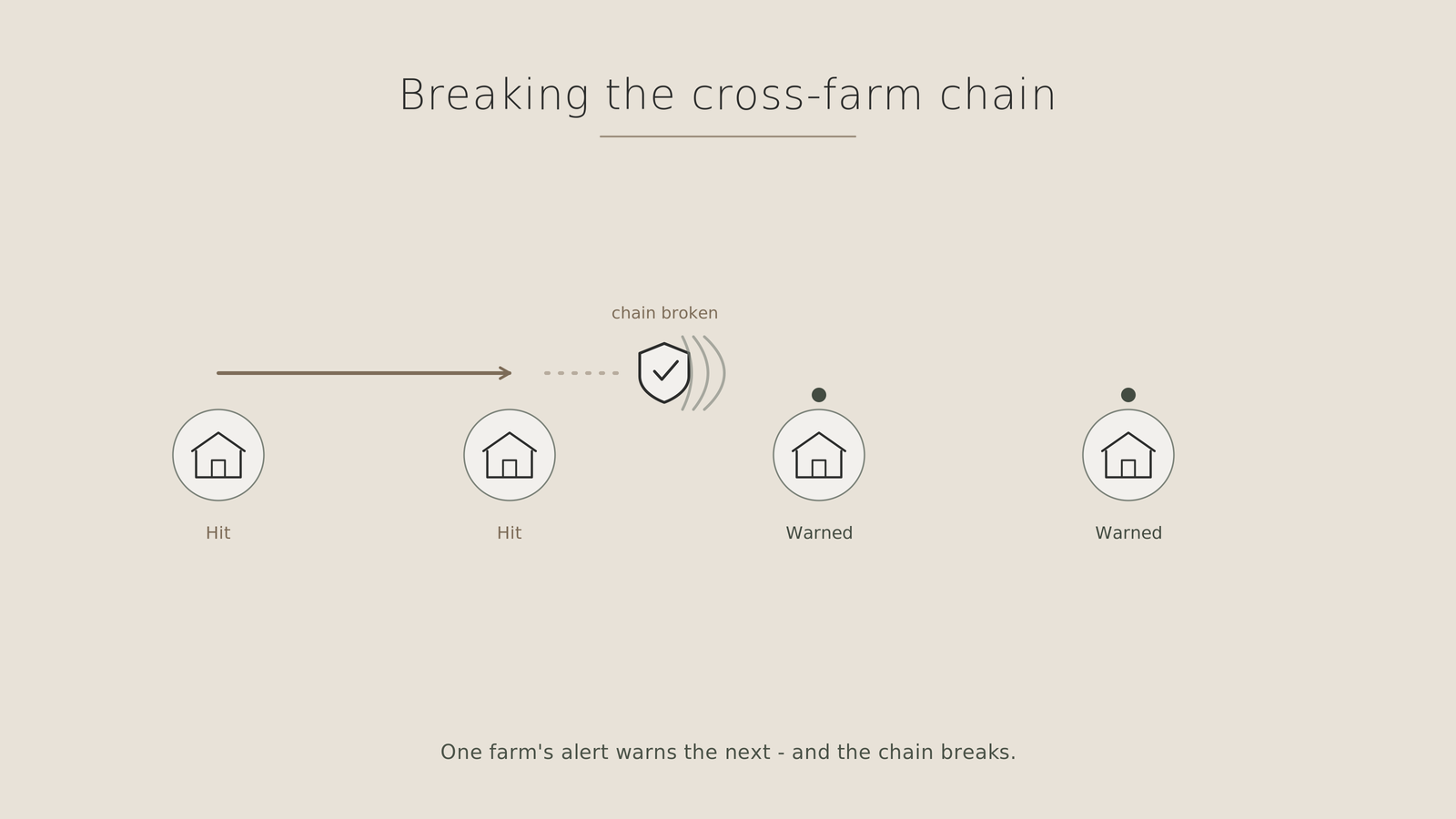
The piece most off-grid systems miss entirely is the neighbour. Rural crime is rarely a single-farm event: the same vehicle works an area in a night, moving from holding to holding. A farm-to-farm alert network — each property relaying warnings to the next over its own radio link — means the second, third and fourth farms get their warning before the vehicle arrives, not after it has left. One farm’s bad night becomes the whole district’s early warning.
This network runs independently of any wider infrastructure. When one farm’s motion sensor triggers an alert, that alert travels by radio to neighbouring holdings whose systems receive and relay it further. The vehicle is identified, described and flagged across multiple properties while it is still in the area. Farms that have agreed a warning routine — a simple code that means ‘vehicle on the move between holdings’ — can mobilise shared attention without needing a formal watch group or emergency services. The cost of this network is near zero; the effectiveness depends entirely on proximity and prior agreement among neighbours.
How should power and communication be sized for winter conditions?
Solar power is reliable enough for British farm security if the system is sized for winter, not summer. The mistake most systems make is specifying panels and batteries for June, then failing in December. Winter sizing means generous battery capacity, low-power electronics and panels positioned for low sun. The system must survive weeks of low light with a margin of safety left in reserve. A system that runs its battery down to zero in a power cut is a system that will fail before spring.
Mobile-signal blackspots deserve particular attention because they are exactly where thieves feel safest. Where 4G exists, a cellular alarm path is a useful backup for reaching your phone when you are away. Where it does not exist, the system must be designed so that on-farm alerting — sirens, lights, radio relays to the farmhouse and neighbours — carries the entire load. The question to ask is not ‘can we reach the internet from here?’ but ‘what happens when the internet cannot be reached at all?’ Designing for the blackspot first is the difference between off-grid security and mains security with a solar panel bolted on.
What is the cost-effective way to start off-grid security?
Cost discipline matters, because farms are businesses with finite budgets and multiple priorities. The right approach is layered: start with the measures that cost little or nothing, then add powered detection at the highest-risk chokepoints, then extend coverage as budget allows. The foundation is gateway discipline — locking regimes that actually work, marking and photographing machinery, agreeing a warning routine with neighbours, and walking your boundary at night to find your own blind spots. These steps reveal where the real risk sits and where money will have the most effect.
A partial system that works in a power cut beats a comprehensive one that fails with the grid. This principle guides every choice: a single solar-powered motion sensor at the field gateway with a siren that sounds locally and a radio alert to neighbours is a system that survives a grid failure and delivers genuine early warning. It costs less than a full-coverage system that depends on mains power and stops working the moment the lights go out. The discipline is to build the skeleton first — perimeter detection, local deterrence, farm-to-farm alerts — then add coverage in layers as investment allows.