Message groups carry the daytime intelligence; radio-linked alert networks carry the 2am alarm no one is awake to read. A farm-to-farm relay network spreads a warning across your district in seconds with no mobile signal and no centre to fail — and works best when paired with your existing human scheme. Both have a place; together, they cover round the clock.
Why farm watch schemes matter, and why they have a blind spot
Rural crime is a travelling problem. The vehicle that strikes one holding tonight may check three more before dawn and work the next parish tomorrow. Farm watch schemes exist because neighbours are the one advantage thieves cannot scout away. A sighting shared, a description circulated, a pattern spotted — this is intelligence the police could never gather alone. Districts with active schemes consistently report being harder targets than those without.
The classic scheme works: a phone tree, a WhatsApp group, a police liaison. Every farm should be in one, and starting one is straightforward — a meeting, a map, a contact list, and agreement on what gets reported and to whom. But message groups have a structural weakness. They depend on mobile signal and human attention, and rural crime happens precisely where and when both are weakest. A sighting posted to the group at 2am lands on silenced phones in signal blackspots. By the time it is read over breakfast, the vehicle is two parishes away. The warning arrived; it just arrived after the crime.
This is not a failure of the scheme itself. It is a limitation built into the medium. No amount of commitment from neighbours can make a mobile message travel faster than the signal allows, or make a sleeping farmer read it before dawn.
How radio-linked alert networks work differently
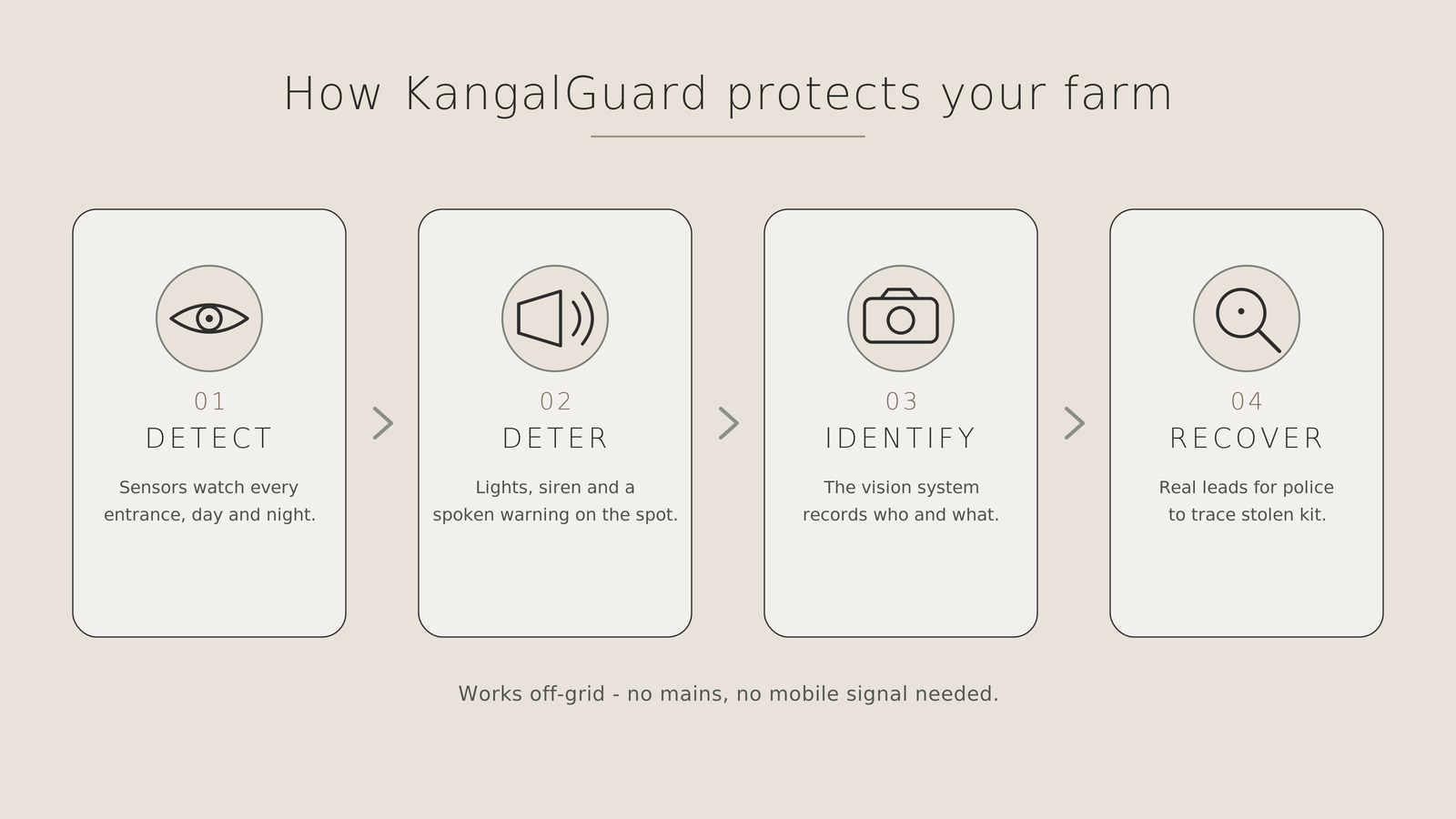
The upgrade is to let the farms warn each other directly, machine to machine. In a radio-linked alert network, one farm’s perimeter detection does not just wake that farmer — it relays the warning over its own radio link to the neighbouring holdings’ systems, which sound their own alerts, in seconds. No internet. No mobile signal. Nobody needs to be awake with a phone in hand.
One farm is hit; every connected property knows while the vehicle is still in the lane. The technology that makes this work is relaying: each farm passes the warning onwards, so coverage grows farm by farm along valleys and lanes far beyond the range of any single link. The system has no centre to fail. The geography that isolates rural properties — long lanes, scattered holdings — becomes the network’s shape rather than its weakness.
This is why the network works where a message group cannot. The warning travels at machine speed, independent of mobile coverage or human wakefulness. It reaches properties that have no phone signal. It does not wait for anyone to notice or decide to forward it. It relays automatically, the moment the first farm detects an intrusion.
What actually changes when neighbours get a live alert
A machine-speed warning changes what neighbours can actually do. When an alert arrives seconds after an intrusion, the response is immediate and visible: lights come on across the district; cameras turn towards the lane; a description and direction reach the police as a live, moving picture, not a report filed hours later. The escape route past the next holding is suddenly lit and watched.
None of this requires anyone to confront anyone. The power of the network is a district that visibly reacts together — which is precisely what opportunists and professionals are checking for when they select a target. A lane where every light goes on at once, where cameras track a vehicle, where police are being called in real time, is not a lane a thief wants to use. The reaction matters more than the confrontation.
This visible, coordinated response is what separates a working alert network from a passive scheme. It moves the deterrent effect from ‘maybe someone will see this’ to ‘this district knows and responds now’.
Why you need both: the human scheme and the radio layer
The WhatsApp group and the radio network are complements, not rivals. The message group still carries what it is designed for: the daytime intelligence. The odd vehicle, the cold caller, the pattern-spotting across weeks. The police liaison still turns that intelligence into action. The radio layer adds the thing the group could never do: the 2am, signal-dead, seconds-fast alarm.
A district running both is covered around the clock. During working hours, neighbours share observations, build context and alert the police to anything unusual. At night, when signal fails and sleep deepens, the radio network becomes the active layer. Each farm’s perimeter detection system watches its own boundary and relays warnings to its neighbours. The human intelligence informs the police during the day; the machine network protects the holdings when the people are asleep.
Starting with the human scheme is the right step. Every farm should have a phone tree and a police contact. Adding a radio-linked layer is a later step that multiplies the value of the scheme by adding speed and reliability to the hours when it matters most.
How to assess whether a radio network is right for your area
A radio-linked alert network starts small. It works with two holdings and grows farm by farm — each new property extends the relay’s reach. You do not need every farm in the area to join. Even a handful of connected farms along a lane, or across a valley, changes how safe that lane feels to work and how visible any intrusion becomes. The network’s benefit arrives long before complete coverage.
Before considering equipment, establish what you already have: an active farm watch group, a police rural crime contact, and agreement from neighbours on what gets reported and to whom. If your group relies entirely on WhatsApp and you experience regular signal blackspots during night hours, or if crime in your district tends to occur when people are asleep, a radio layer addresses a real gap. If your district has reliable signal and active night-time response, the group may be sufficient.
The topology of your land also matters. Scattered holdings, deep valleys, or stone buildings that block mobile signal are the conditions where radio relaying shows its strongest advantage. A tight cluster of farms on higher ground with good coverage may find a WhatsApp group more practical. Assess your actual conditions: where does crime happen, how fast do current warnings travel, and where do you lose signal.
Starting: the neighbour agreements every network needs
Whether you build a human scheme, add a radio layer, or run both, the foundation is neighbour agreement. What gets reported? A vehicle seen twice in a week, or every unfamiliar car? Cold callers? Unusual activity on land boundaries? Who do you call first — the farm next to you, or the police? How do you log incidents so patterns emerge? These agreements take an hour to establish and years to prove their value.
The free Defence Kit available from the studio walks through ten things every farm can do this week with no cost and nothing to install. It includes the neighbour contact mapping and incident-logging templates that make any network — message group or radio relay — work. Start there. Build the human layer first. Then, if your conditions demand it, add the technology that lets the network reach your farms at machine speed, 2am or 3am, in the signal blackspots where the warning matters most.