
A PIR detector reads infrared heat from a moving body and triggers an alert; a motion sensor reads light or vibration and needs a clear line of sight to work. On a farm, PIR wins because it ignores wind, leaves, gates and sheets blowing in the yard, and it sees through darkness and fog. Motion sensors are cheaper and simpler in open industrial yards where nothing moves except intruders. Most farm perimeters need PIR.
How PIR and motion sensors actually see an intruder
A PIR detector has a lens that collects infrared radiation, the heat every living body gives off. When a warm shape moves through the detector's field, the lens picks up the change and triggers. PIR stands for passive infrared. The word 'passive' matters: the detector sends nothing out, it only listens for heat. That is why it works in complete darkness.
A motion sensor (also called a microwave detector) sends out a signal and watches for the signal to bounce back differently when something moves. Some motion sensors read light changes instead. Either way, they need to see the movement clearly. A tree branch moving in the wind will trigger them just as much as a person will.
Why motion sensors fail on farms and rural holdings
A farm yard has wind, loose gates, sheets, leaves and branches close to your perimeter fence. A motion sensor will trigger every time the wind moves the vegetation near it. You end up tuning the sensitivity so low that an intruder moving slowly past the fence will not trigger it at all. By the time you have adjusted the settings enough times to stop the false alarms, the detector is nearly useless.
Motion sensors also need an unbroken line of sight from the detector to the intruder. A fence post, a parked trailer or a low-hanging branch can put the intruder in a shadow where the detector cannot see them. A farm yard layout changes with the seasons, you move equipment, park differently, cut trees. Motion sensors force you to move or reinstall them constantly.
Organised gangs work at night. A motion sensor that relies on light changes is blind in darkness. PIR sees heat in pitch black, in fog, in rain and in snow. It sees the intruder coming.
When motion sensors do work, and why PIR still wins on your perimeter
Motion sensors work well in places with no wind and nothing moving except people, a secure compound with smooth ground, no trees nearby, locked gates and clear sight lines. Industrial yards sometimes fit that picture. A farm yard does not. You have wind, animals, loose fencing, gates that swing, branches that move, dust clouds and changing layouts.
PIR detectors ignore wind, moving leaves and gates because they read heat, not movement. An intruder at body temperature shows up clearly whether a gate is swinging or not. PIR also ignores small animals, a cat or a fox does not trigger it the way motion sensors do. On a farm, that means fewer false alarms and more reliable alerts when a person approaches your boundary.
What KangalGuard uses and why it matters for your holding
KangalGuard uses PIR detectors because the farms and rural holdings it protects have exposed perimeters, changing weather and complex layouts. Your perimeter fence is outdoors, often miles from the nearest mains power or mobile signal. A detector that triggers on every gust of wind is useless to you. You need something that sees an intruder coming and stays quiet until a person actually appears.
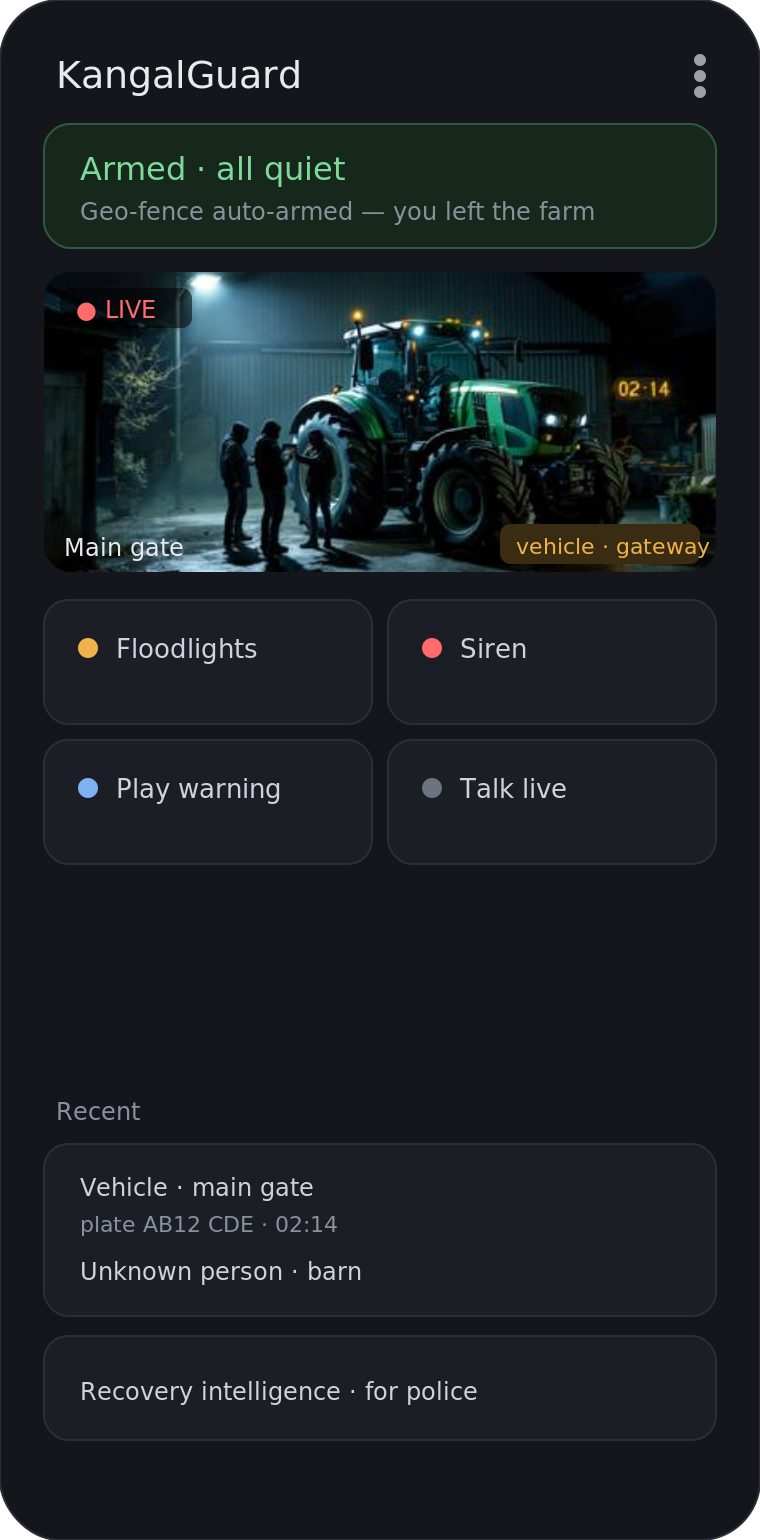
KangalGuard's PIR units are placed at the points where organised gangs probe, gates, field access, yard boundaries. They work off-grid and independently of mobile signal. Because they use PIR, they deliver reliable alerts in darkness, fog and wind without the weeks of tuning a motion sensor would cost you. The alert chain leads to identification and recovery intelligence the police can actually use.
PIR limitations and what to watch for
PIR detectors do not see through walls, glass or solid barriers. They read heat in their field of view, typically a cone or a fan shape. You need to know exactly where your perimeter threat points are so the PIR lens faces the right approach. A detector placed where an intruder can walk around it without crossing its field is wasted. KangalGuard surveys your holding and places detectors where they cover actual approach routes.
PIR is slower to react than motion in cold environments because the temperature difference is smaller. On a freezing night, a detector needs longer to register a warm body moving through a cold field. This is rarely a problem for perimeter security, you are watching for people, not split-second reactions, but it is why placement and detector angle matter more.
How to choose the right detection for your farm
If your perimeter has wind, vegetation, loose fencing or unpredictable layouts, PIR is the right choice. If your holding sits in darkness for hours and organised gangs work at night, PIR is the right choice. If your site is rural, off-grid or in a mobile black spot, PIR works independently where motion sensors fail because they have no signal to send alerts on. Choose PIR for farms, rural estates, arable holdings and smallholdings. Motion sensors belong on secure compounds with controlled layouts and daylight working hours.
Protect your farm by starting with an honest audit of where intruders actually approach, what the weather does to your perimeter, and whether you have reliable power and signal. KangalGuard listens to all three before recommending detection. The result is a perimeter that sees intruders coming, delivers alerts that survive fog and darkness, and turns the incident into recovery intelligence.