
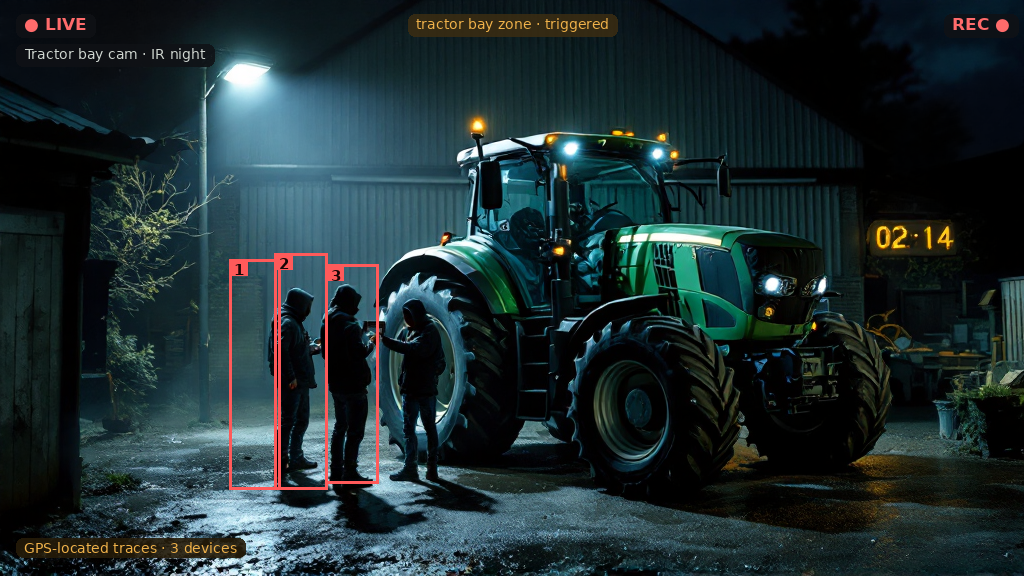
A Power Over Ethernet (PoE) camera draws power and sends data through a single Ethernet cable, removing the need for a mains connection or mobile signal at the camera itself. For farms and rural holdings, this means security cameras work in the dead zones where GSM alarms go silent. The camera connects to a local recorder or network hub, which can operate independently of the internet, so you keep the footage and the evidence regardless of infrastructure around you.
What PoE camera systems actually do
A PoE camera is powered and controlled through a single network cable, typically Ethernet. The injector (a small device on your local network) sends both the electrical power and the data signal down the same wire to the camera. At the camera end, the power is separated and used to run the lens, sensor and processor, while the data stream records and transmits footage. This single-cable design is what makes PoE essential for rural security: you do not need to run mains power to a field gate, a perimeter barn or a remote holding. You run one cable from your recorder or network hub to the camera, and it works.
Why this matters on a farm or rural holding
Rural farms and estates often sit beyond mains electricity and outside mobile coverage areas. A traditional CCTV system needs mains power at each camera and a mobile connection to alert you when something happens. In a rural black spot, both fail. A PoE system changes this: the camera runs off the single cable, and if your recorder sits on your local network (not dependent on cloud or mobile signal), you own the footage the moment it is recorded. You do not wait for a signal to arrive or pay a monitoring service to hold it for you. The footage is yours, stored locally, and a police officer can review it while you are still on the phone about the incident.
For a multi-site estate or a large holding with scattered buildings, this matters enormously. You can place cameras where they stop intruders before they reach the main yard, without running power lines across fields or betting your security on mobile networks that do not reach there. For arable operators carrying high-value kit, livestock farmers protecting stock, and smallholders on tight budgets, PoE removes the infrastructure barrier that keeps cheap systems from working where they are needed most.
PoE camera systems and mobile independence
A PoE camera on a local network does not need mobile signal to record, to store footage or to alert you locally. However, if you want to view live footage or receive alerts on your phone when you are away from the farm, the recorder still needs connectivity. This is where the design choice matters: a PoE system lets you separate the recording (which happens locally, with or without signal) from the notification (which uses whatever connectivity you have). If you have no mobile signal but you do have broadband at the main house, you can connect your recorder there and view the cameras over WiFi when you are indoors. If you have neither, the system still records to a local drive and you review it manually. A monitored alarm system cannot do this: it goes silent the moment the signal drops. A PoE system keeps working.
Why leaving rural security to mobile networks costs you
A farm in a mobile black spot that relies on a GSM-based alarm loses its connection the moment the mast nearest to you goes down, or if you are simply too far away. You do not know an intrusion has happened until you see the gate open the next morning. By then, the footage from a cloud-based system is gone (cloud services purge footage after a set time), and if the network was down during the incident, there is no video at all. The police have nothing to work with. A GSM monitoring service costs you monthly whether the signal is there or not, and that money buys you nothing if the connection fails. You are paying for protection you cannot use.
A PoE system with local storage breaks this trap. The camera records whether your broadband is up or down. The recorder sits on your local network and keeps footage until you decide to delete it. You own the evidence. When you do have connectivity, the system can alert you or let you check in remotely, but the core protection, the recording, the timestamp, the proof, does not depend on it. Weeks later, when the police recover a stolen quad or catch someone who came back to the same gate, you have the footage and the metadata. That evidence turns into recovery leads the police can actually act on.
How to know if PoE is right for your holding
PoE works best when you have a network hub or recorder on your property that you can physically connect cameras to via cable. If you have a main building with broadband, you can run Ethernet cable out to camera positions and set up a local recorder indoors. If your holding is too dispersed or you have no fixed base with power and broadband, you may need a hybrid approach: PoE cameras at some sites, a mobile-linked system at others. A PoE system is also an investment in your own hardware, you buy the cameras, the injector and the recorder, and they are yours. You do not pay a monthly monitoring fee, and you do not lose access if you stop paying a service. For the multi-generational farmer, the estate manager running several sites and the arable operator moving gear between fields, this ownership and independence are often worth the upfront cost.
For a smallholder or a farmer in a rural-crime network, a PoE system gives you the evidence to warn other farms in the district when someone tries your gate. If you keep footage locally and the police can retrieve it quickly, your recording becomes intelligence the whole neighbourhood can use. That turns a single incident into a collective defence.
What happens next with farm security that actually works
A PoE camera system is only as good as the recorder, the network hub and the positioning. Installation and configuration matter as much as the hardware. You need cameras placed to catch intruders at the perimeter, not just at the gate, and the recorder positioned so you can review footage and extract evidence without losing sight of the live feed. The system also needs to be designed so it keeps working even if part of your broadband goes down or a camera loses power temporarily.
This is where the difference between building a system yourself and getting it audited by someone who works in rural security becomes clear. A farm security audit looks at where intrusions actually happen on your holding, where the gaps are, which camera positions see the approach routes, and how to record and retrieve footage so the police can act on it. It also sets up the network so the system is resilient, and trains you to spot what the footage actually shows when the time comes.